
Jump rope benefits, system by system
Jumping rope trains four systems at once — heart, bone, the calf-and-ankle complex, and timing. The cardio and coordination gains arrive in weeks; the bone and tendon gains take months. Most jump rope benefits are real, but a few popular ones don't survive a close look.
Jump rope benefits by system, at a glance
| System | What actually changes | Rough timeline | What drives it |
|---|---|---|---|
| Cardiovascular | Stroke volume up, resting heart rate down | 4–8 weeks | Sustained minutes at vigorous effort |
| Bone | Mineral density at foot, tibia, hip | Months | Impact magnitude plus rest between bouts — not total reps |
| Tendon and calf | Achilles and plantar-flexor stiffness | 2–3 months+ | Repeated short ground contacts |
| Neuromuscular | Timing, rhythm, foot speed | Days to weeks | Practice, especially new rope variations |
| Metabolic | Energy expenditure, insulin sensitivity | Weeks | Total work done, not the mode of exercise |
Most skipping rope benefits are dose- and tissue-dependent: judging the whole thing by how you feel after three weeks judges only the fastest-adapting system you own.
Cardiovascular: stroke volume up, resting heart rate down
Skipping is vigorous for almost everyone who tries it. Activity compendiums put rope jumping around 9 to 12 METs depending on cadence, and public health guidelines call for 150–300 minutes of moderate activity or 75–150 minutes of vigorous activity per week, with vigorous minutes counting double. Ten honest minutes of rope covers the same ground against that target as twenty minutes of brisk walking.
The left ventricle fills more completely and ejects more blood per beat, so the same cardiac output needs fewer beats — the effort that spiked your heart rate in week one sits noticeably lower by week six.
Most beginners can't string together more than 30 to 60 seconds before the rope catches a heel, so the first few weeks are interval training whether you planned it or not — a fine stimulus, just not a continuous one.
Bone: the impact is the mechanism, not a side effect
Bone remodels in response to mechanical strain that's large, applied fast, and unfamiliar — landing from a skip delivers all three. That's why swimming and cycling are nearly silent to the skeleton, and why jump rope bone density gets discussed alongside hopping and plyometric work.
First, the response saturates fast: bone cells lose sensitivity to a repeated load within a few dozen cycles, after which more reps add fatigue rather than signal. Rest restores that sensitivity, so two short sessions hours apart beat one long one.
Second, it's site-specific. Skipping loads the feet, tibia, and hip, and does nothing measurable for the wrist or lumbar spine — the sites osteoporosis screening actually checks. Treat it as one input to bone health, not the whole program.
Bone is also slow: a remodeling cycle runs months. Ramp up from zero to fifteen minutes a day because your lungs can handle it, and the tibia is what objects — medial shin pain in week three is the most common way a new skipping habit ends.
Calf, ankle, and Achilles adaptation
The plantar flexors and Achilles do most of the work in a skip; quads and glutes contribute far less than people assume, since the ankle absorbs and returns most of the energy. Over months the tendon gets stiffer in the useful sense — storing and returning elastic energy with less loss, one ingredient of running economy.
Tendon lags muscle, though. Strength moves in six to eight weeks while tendon stiffness runs slower, and that mismatch — a calf producing more force than the tendon is ready to transmit — is where most Achilles complaints start. Slow, heavy calf raises close that gap better than rope alone.
Neuromuscular: timing, not foot-eye coordination
The coordination claim is real but usually misdescribed: you don't watch the rope. Past the first week, timing comes from wrist position and the sound of the cord hitting the floor — a rhythmic, proprioceptive skill more than a visual one.
Mechanically, skipping trains the fast stretch-shortening cycle — ground contacts measured in fractions of a second, ankle acting as a spring. That's a real reactive-strength stimulus that transfers to sports needing quick feet, but it's no substitute for heavy plyometric work if you're chasing vertical jump — the forces are too low. Skill adapts fastest of all: a visible change within two weeks, double-unders within a couple of months.
Metabolic cost, and the number that gets inflated
Per minute, rope is expensive. At roughly 11 METs a 70 kg adult burns on the order of 750 to 800 calories per hour of continuous skipping — a ceiling nobody actually skips long enough to hit. A realistic 20-minute session with rest intervals lands in the low hundreds. The "1,000 calories an hour" figure that circulates applies that pace to a session that doesn't exist outside competition.
The durable metabolic effects are the ones shared by all vigorous interval work: better insulin sensitivity, higher VO2max, a strong work-to-time ratio. None of it is unique to the rope — it's just a cheap, portable way to buy it.
The benefits of jumping rope that get oversold
Spot fat reduction. Skipping doesn't preferentially burn fat from the calves, thighs, or midsection. Fat mobilization is systemic and follows energy balance — no exercise selects a region. Rope can change how calves look by adding muscle underneath, a different mechanism and occasionally the opposite of what someone wanted.
It replaces resistance training. It doesn't. It loads the calves and ankles hard, the hips moderately, and everything above the waist barely at all — a rope weighs a few ounces and the shoulders work mostly isometrically. Muscle-strengthening sits in the guidelines as a separate two-days-a-week item for a reason: rope covers no posterior chain, no upper-body pulling, nothing single-leg.
It's low-impact if you land softly. Skipping is high-impact by design — that's the point. Landing on two feet splits the load, so peak force per leg runs lower than in running, but the landings arrive far more often: roughly 120 to 180 a minute against about 90 foot strikes per leg for a runner.
Why progress stalls after week three
The first three weeks improve because the skill improves — fewer trips, longer sets, less flailing. After that, most people flatten out because volume stops rising: same five minutes, same cadence, same variation, week after week. Every adaptation above is dose-responsive, so a flat dose returns a flat result.
Three levers matter, in order of usefulness: total contacts per week, longest continuous set, then variation (single-unders → alternating foot → single-leg → double-unders). Cadence comes last, not first.
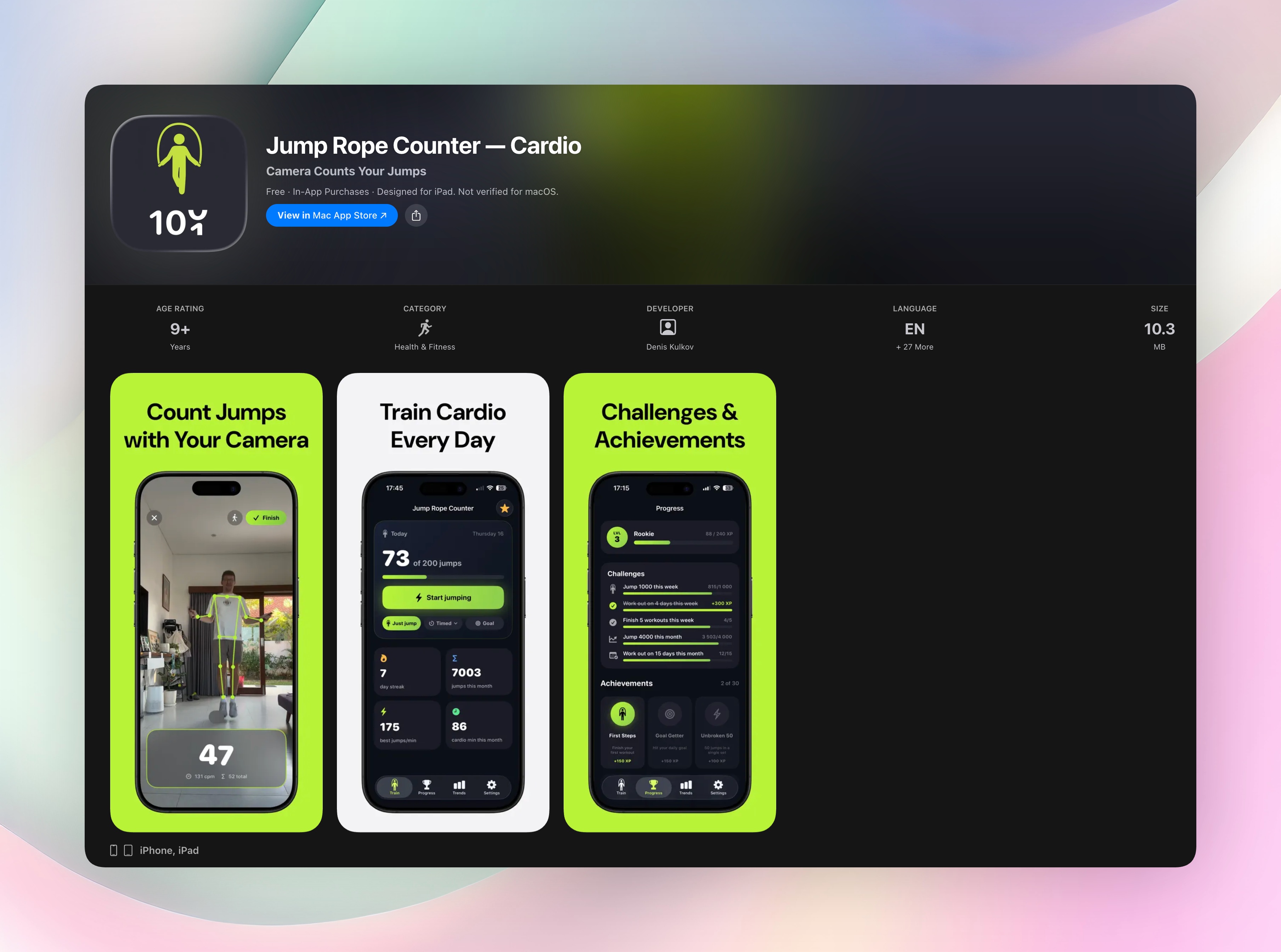
This goes unnoticed because skipping is almost never counted. Runners know their weekly mileage and lifters know their tonnage; skippers know "I did some rope for a while." Jump Rope Counter is a jump rope counter app for iPhone that counts jumps with the camera — enough to turn "I did some rope" into an actual number for the session.
Who it suits, and who should be careful
It suits anyone with a few feet of ceiling and ten minutes: runners wanting impact without more mileage, court and combat athletes who need footwork, people who travel.
Beginners carrying substantial extra weight should be careful — the issue is impact count per session, so start with 20-second sets, long rests, and a step-through instead of a two-foot bounce, and apply the same caution with current knee, Achilles, or plantar fascia symptoms. If your only surface is concrete, fix that first: wood, rubber flooring, or a mat changes the loading more than any shoe will. With pelvic floor symptoms, clear high-impact work with a clinician rather than pushing through.
Is jumping rope good for you? For most healthy adults, yes, and unusually so per minute spent — provided you treat the ramp-up as the hard part.
FAQ
Is jumping rope good for you if you have bad knees?
That's a question for a physio, not the internet — it depends on the diagnosis. Skipping is high-frequency loading at moderate force per leg; some knees tolerate it better than running, some worse. Start with 20-second sets on wood or rubber and judge by how the knee feels the next morning.
What are the benefits of jumping rope every day?
Daily rope mostly buys skill and cardio consistency. For bone it's less ideal than it sounds, since the loading response saturates and needs rest — short sessions beat one long one. The real risk is cumulative shin and Achilles impact; keep the daily dose to three to five minutes.
How long does it take to see jump rope benefits?
Coordination inside one to two weeks; resting heart rate and perceived effort in four to eight; calf and tendon changes across two to three months. Bone changes run on a scale of months and aren't something you'll feel — they show up on a scan or not at all.
Does jumping rope build calf muscle?
It builds calf endurance reliably, and some size in people starting untrained. The stimulus is many low-force contractions rather than a few high-force ones, closer to endurance work than hypertrophy training. Heavy calf raises add more size and some Achilles protection.
Is skipping rope better than running?
Different tools. Energy cost per minute is comparable at similar intensity; rope needs less space and no weather, and it trains ankle stiffness that running doesn't. Running wins on continuous duration and is easier to sustain for 40 minutes. Plenty do both, using rope for the short, dense sessions.
Free Jump Rope Counter tools
- Calories Burned CalculatorChoose an activity, enter its intensity, your duration and body weight, then get an estimate of calories burned per minute and total.
- Cardio Weekly PlannerPlan how much cardio per week with a simple schedule of minutes by intensity, a guideline comparison and a printable week view.
- Cycling Calories CalculatorEstimate calories burned cycling from your duration or distance, average speed, terrain and body weight. See calories per hour, per mile or km, and the MET used.
- Jogging Calories CalculatorEstimate calories burned while jogging from your body weight and either pace plus duration or distance plus time. See calories per mile, per km and the MET band used.
- Jump Rope Calories CalculatorEnter your body weight, session duration and jump rope pace to estimate total calories, calories per minute and the equivalent running time at 8 km/h.
- Jump Rope Challenge GeneratorCreate a deterministic jump rope challenge from your length, starting target and weekly progression percentage.
- Jump Rope Length by Height CalculatorEnter your height and jump-rope style or skill level to get a recommended rope length and a practical acceptable range.
- Jump Rope Workout for Beginners PlannerChoose your current level, available minutes and preferred work-to-rest ratio to build a progressive beginner jump-rope session.
- Jump Rope Workout Routine BuilderCreate a structured jump-rope routine with exercise blocks, work times, rest times and total interval targets.
- Jumping Jacks Calorie CalculatorEstimate how many calories burned doing 100 jumping jacks, or calculate a different rep count or duration using your weight, pace and intensity.
- Push Ups Calorie CalculatorEstimate calories burned, calories per rep, time taken and the reps needed to reach a calorie target.
- Steps to Calories CalculatorEstimate how many calories burned in 10000 steps, the distance those steps cover and the walking time at your chosen pace.
- Treadmill Calories CalculatorEstimate treadmill calories burned from speed, incline, duration, body weight and whether you are walking or running.
- Walking Calories CalculatorEstimate calories burned, calories per mile and kilometer, time taken and steps from your walking pace, incline, body weight and distance or duration.
- Zone 2 Heart Rate CalculatorCompare two methods for estimating your zone 2 heart rate range, then see the complete five-zone table. Enter a measured maximum heart rate when you have one.