
Jump rope workout routines that actually progress
A jump rope workout is one of five structures with different numbers plugged in: steady state, 30/30 intervals, Tabata, EMOM by rep count, or a pyramid ladder. Pick the structure that matches your goal, then set the work, rest, and jump targets. All five are written out below.
Pick the structure before you pick the numbers
Every session answers two questions: how long the hard part lasts, and what ends it — a clock or a rep count. Skill decides which structures are even available. Tabata on a rope you trip every fourth jump isn't Tabata; it's four minutes of untangling cable.
| Structure | Work / rest | Session length | Fits |
|---|---|---|---|
| Steady state | 3–10 min continuous, 60–90s rest | 20–30 min | Aerobic base, low skill demand |
| 30/30 intervals | 30s hard / 30s easy | 10–20 min | First hard interval work |
| Tabata | 20s max / 10s rest × 8 | 4 min per block | Trained jumpers, short window |
| EMOM by reps | Fixed reps, rest the remainder | 10–20 min | Measurable week-to-week progress |
| Pyramid ladder | Rising then falling rep counts | 12–18 min | Pacing practice, variety |
1. Steady state: the base under every jump rope routine
Continuous single-unders at a pace you could hold a broken conversation at. For most people that's somewhere between 100 and 130 jumps per minute — fast enough that you're breathing hard, slow enough that your form doesn't degrade in the third minute.
Start with three blocks of three minutes, 60–90 seconds of walking between them. Add a minute per block each week until you can hold ten minutes unbroken — roughly 1,000–1,300 jumps in one piece. This is where most of the jump rope benefits people are chasing accumulate: aerobic base plus calf and Achilles resilience. It's the least glamorous part of any jump rope routine, which is why most people skip straight to intervals and then wonder why their calves are wrecked for three days.
If you're still tripping every 15–20 jumps, the limiter is skill, not fitness. Work through a jump rope for beginners progression first — a trip mid-interval costs five seconds of rope handling and the entire point of the interval.
2. 30/30 intervals: the simplest jump rope HIIT workout
Thirty seconds hard, thirty seconds easy, repeated 10 to 20 times. "Hard" means about 85–90% of your top cadence — roughly 60–75 jumps in the window for most intermediate jumpers, or unbroken double unders if you already have ten in a row on demand. The rest half is a slow walk or a light shuffle, not a collapse onto the floor.
Ten rounds is a real session. Start at eight if you're new to this, and add two rounds a week until you hit twenty. Only then start shortening rest: 30/20 first, then 30/15. Cutting rest before you can hold twenty even rounds turns a jump rope HIIT workout into a slow fade where the last six rounds are garbage reps. The 1:1 ratio is forgiving on purpose — it keeps rope speed honest across the whole session, which matters more than any single round being maximal.
3. Tabata: 20 seconds on, 10 off, eight rounds
The protocol is fixed: 20 seconds of maximum effort, 10 seconds of rest, eight rounds, four minutes total. On a rope that means top-speed single-unders or continuous double unders — nothing you can pace.
Jump rope tabata has one honest test: count every round and score the block by the lowest one. If round eight matches round one, round one wasn't hard enough. Expect reps to fall off as it goes — a real all-out effort loses ground round to round; if the count holds flat, it wasn't maximal.
Do one block, two at most with five minutes between them. It's a finisher bolted onto a session, not a session. Six blocks in a row is something else wearing the name.
4. EMOM by rep count: intervals that scale as you get faster
At the top of each minute, complete a fixed number of jumps, then rest whatever's left of the minute. Repeat for 10 to 20 minutes.
Pick the rep target so the work takes 40–50 seconds. At 130 jumps per minute, 100 single-unders takes about 46 seconds and leaves 14 seconds of rest — hard but sustainable for 12 rounds. If that's too much, drop to 70. Advanced version: 20–30 double unders per minute, same logic.
The rep target is what separates this from every timed structure. You can coast through a 30-second round and the clock still lets you leave. You can't coast through 100 jumps — you finish later and rest less, which is exactly the feedback you want.
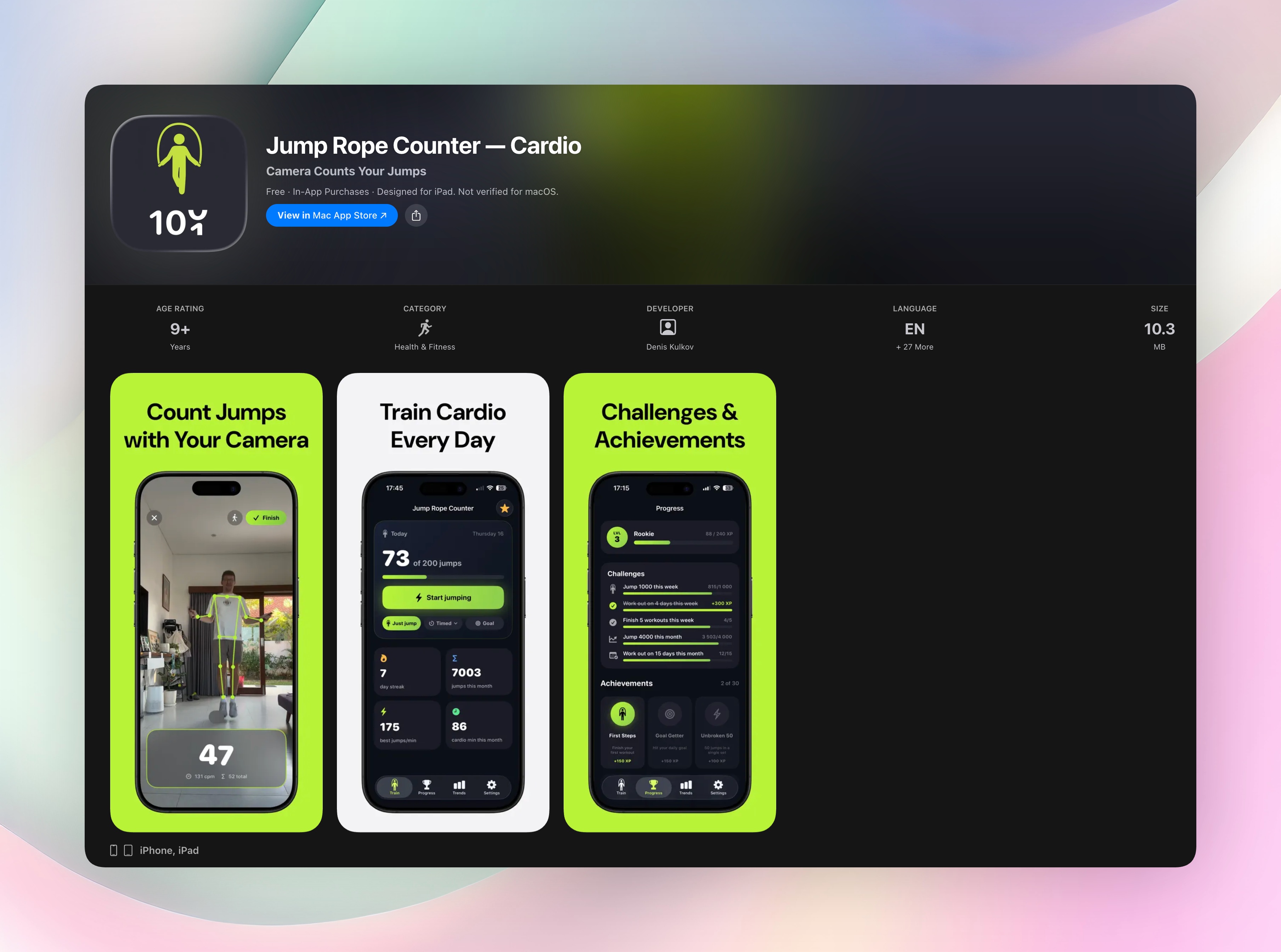
Holding the count while your heart rate is redlining is the part that falls apart. Most people lose track past 60 and either short the round or overshoot it. Jump Rope Counter is a jump rope counter app for iPhone that counts jumps with the camera, so the rep target is what ends the interval instead of your best guess at it.
5. The pyramid ladder
Climb and descend by rep count: 20, 40, 60, 80, 100, 80, 60, 40, 20. That's 500 jumps per ladder. Rest 30 seconds between rungs on the way up and 45 on the way down, when fatigue has arrived and your rope speed hasn't recovered.
One ladder runs about 10 minutes. To make it harder without adding rounds, raise the top rung to 120 or cut every rest to 20 seconds — change one variable at a time so you know which one you adapted to.
A descending-only ladder — 100, 90, 80, down to 10 — is the better version on a flat day. Every rung is easier than the last, so it finishes even when the first one felt awful.
Time or reps: which one should end the interval
Time-based work (30/30, Tabata) is right when effort is supposed to be maximal and counting is impossible. The clock is neutral: it ends the round whether you were flying or shuffling.
Rep-based work (EMOM, ladders) fixes the workload instead, and the difference shows up as you get faster. At 110 jumps per minute a 30-second round is 55 jumps; at 150 it's 75 — the clock reports the same session both times even though the work grew by a third. A jump rope interval workout built on reps holds the standard still, so progress reads as seconds saved and rest gained.
Rule of thumb: time for max-effort and group settings, reps for anything you want to track across a month.
A four-week jump rope workout plan
This plan grows volume and leaves intensity alone. Top cadence and double-under density stay put; only total jumps move. Calves and Achilles tendons adapt slower than lungs do.
Week 1 — three sessions, ~2,400 jumps total
- Day A: steady state, 3 × 3 min, 90s rest
- Day B: 30/30 × 10
- Day C: EMOM 70 × 12 min
Week 2 — three sessions, ~2,900 jumps
- Day A: steady state, 3 × 4 min
- Day B: 30/30 × 12
- Day C: EMOM 70 × 12 min
Week 3 — four sessions, ~3,500 jumps
- Day A: steady state, 2 × 5 min
- Day B: 30/30 × 14
- Day C: EMOM 80 × 12 min
- Day D: descending ladder, 100 down to 10
Week 4 — four sessions, ~3,900 jumps
- Day A: steady state, 10 min unbroken
- Day B: 30/30 × 16
- Day C: EMOM 90 × 12 min
- Day D: full pyramid ladder, top rung raised to 120
Two rules govern the block. If calf soreness is still there 48 hours later, repeat the week instead of advancing it. And if rep targets start costing you trips, drop the target by 10 — tripping teaches your body to jump differently, and that's harder to undo than a missed round.
FAQ
How long should a jump rope workout be?
Ten to thirty minutes of actual rope time. Interval sessions land at 10–20 minutes, steady state at 20–30. Total jumps is the more useful measure than clock time — 1,500–2,500 jumps is a solid session for a conditioned jumper.
How many jumps a day is good for jump rope conditioning?
Beginners should build to 500–1,000 jumps in a session, spread across short blocks. A conditioned jumper handles 6,000–10,000 jumps a week across three or four sessions, which covers general jump rope conditioning. Getting there takes months — add 10–20% to the weekly total at a time, not more.
Can I jump rope every day?
Yes, if you alternate hard and easy days by volume. The limiter is connective tissue in the calves and feet, not aerobic capacity, so follow a 2,000-jump day with a 600-jump skill day. Daily skill practice at low volume is fine.
What rope works best for interval training?
A thin PVC speed rope for timed and rep-based intervals; a beaded rope for learning, since it gives audible feedback. Length rules vary by use: standing on the rope's midpoint, handles reaching your armpits suits general fitness, while speed jumpers size shorter, to about sternum height. Weighted ropes of a quarter to one pound slow cadence, so don't compare rep counts across ropes.
Should I count jumps or time my rounds?
Count jumps when you want progress you can compare week to week; time rounds when the effort is meant to be maximal. Most programs use both.
Free Jump Rope Counter tools
- Calories Burned CalculatorChoose an activity, enter its intensity, your duration and body weight, then get an estimate of calories burned per minute and total.
- Cardio Weekly PlannerPlan how much cardio per week with a simple schedule of minutes by intensity, a guideline comparison and a printable week view.
- Cycling Calories CalculatorEstimate calories burned cycling from your duration or distance, average speed, terrain and body weight. See calories per hour, per mile or km, and the MET used.
- Jogging Calories CalculatorEstimate calories burned while jogging from your body weight and either pace plus duration or distance plus time. See calories per mile, per km and the MET band used.
- Jump Rope Calories CalculatorEnter your body weight, session duration and jump rope pace to estimate total calories, calories per minute and the equivalent running time at 8 km/h.
- Jump Rope Challenge GeneratorCreate a deterministic jump rope challenge from your length, starting target and weekly progression percentage.
- Jump Rope Length by Height CalculatorEnter your height and jump-rope style or skill level to get a recommended rope length and a practical acceptable range.
- Jump Rope Workout for Beginners PlannerChoose your current level, available minutes and preferred work-to-rest ratio to build a progressive beginner jump-rope session.
- Jump Rope Workout Routine BuilderCreate a structured jump-rope routine with exercise blocks, work times, rest times and total interval targets.
- Jumping Jacks Calorie CalculatorEstimate how many calories burned doing 100 jumping jacks, or calculate a different rep count or duration using your weight, pace and intensity.
- Push Ups Calorie CalculatorEstimate calories burned, calories per rep, time taken and the reps needed to reach a calorie target.
- Steps to Calories CalculatorEstimate how many calories burned in 10000 steps, the distance those steps cover and the walking time at your chosen pace.
- Treadmill Calories CalculatorEstimate treadmill calories burned from speed, incline, duration, body weight and whether you are walking or running.
- Walking Calories CalculatorEstimate calories burned, calories per mile and kilometer, time taken and steps from your walking pace, incline, body weight and distance or duration.
- Zone 2 Heart Rate CalculatorCompare two methods for estimating your zone 2 heart rate range, then see the complete five-zone table. Enter a measured maximum heart rate when you have one.