
A 30-day jump rope challenge with a target for every day
A jump rope challenge works best when every day has a number. This 30-day plan gives you one: it starts at 100 jumps and finishes at 1,000 in a single session, building for three days and easing off on the fourth.
How this jump rope challenge is built
Most 30-day plans ramp in a straight line — 100 on day 1, 1,000 on day 30, add about 30 a day. Calves don't adapt on a straight line. Jumping is a small impact repeated hundreds of times, and the tissue that quits first is almost never your heart. It's the soleus, the Achilles, and the small muscles under the arch.
So this jump rope progression runs in four-day blocks: three build days, then a light day cut back well below the block's peak. The light day isn't a rest day and isn't optional — it's what lets each block start higher than the last one ended.
Two rules are baked into the numbers. The daily figure is a total, not an unbroken set: break 400 into four sets of 100 with 30–45 seconds between them if that's what the day needs. And missed reps get repeated — trip at 380 of 400, restart, finish the last 20.
The 30-day jump rope challenge, day by day
The intermediate column is exactly double the beginner column: same curve, same rest pattern, twice the volume. Take the beginner track if 100 continuous jumps is still a coin flip, the intermediate track if you already skip a few times a week. If the basic bounce itself is new, spend a week on mechanics with our jump rope for beginners guide before day 1.
| Day | Beginner | Intermediate | Day type |
|---|---|---|---|
| 1 | 100 | 200 | Build |
| 2 | 130 | 260 | Build |
| 3 | 160 | 320 | Build |
| 4 | 100 | 200 | Light |
| 5 | 190 | 380 | Build |
| 6 | 220 | 440 | Build |
| 7 | 250 | 500 | Build |
| 8 | 150 | 300 | Light |
| 9 | 280 | 560 | Build |
| 10 | 310 | 620 | Build |
| 11 | 350 | 700 | Build |
| 12 | 200 | 400 | Light |
| 13 | 390 | 780 | Build |
| 14 | 430 | 860 | Build |
| 15 | 470 | 940 | Build |
| 16 | 250 | 500 | Light |
| 17 | 510 | 1,020 | Build |
| 18 | 560 | 1,120 | Build |
| 19 | 610 | 1,220 | Build |
| 20 | 320 | 640 | Light |
| 21 | 650 | 1,300 | Build |
| 22 | 700 | 1,400 | Build |
| 23 | 750 | 1,500 | Build |
| 24 | 400 | 800 | Light |
| 25 | 800 | 1,600 | Build |
| 26 | 850 | 1,700 | Build |
| 27 | 900 | 1,800 | Build |
| 28 | 450 | 900 | Light |
| 29 | 950 | 1,900 | Build |
| 30 | 1,000 | 2,000 | Build |
The beginner track crosses 500 jumps a day at day 17, which is usually where unbroken sets start stretching out on their own.
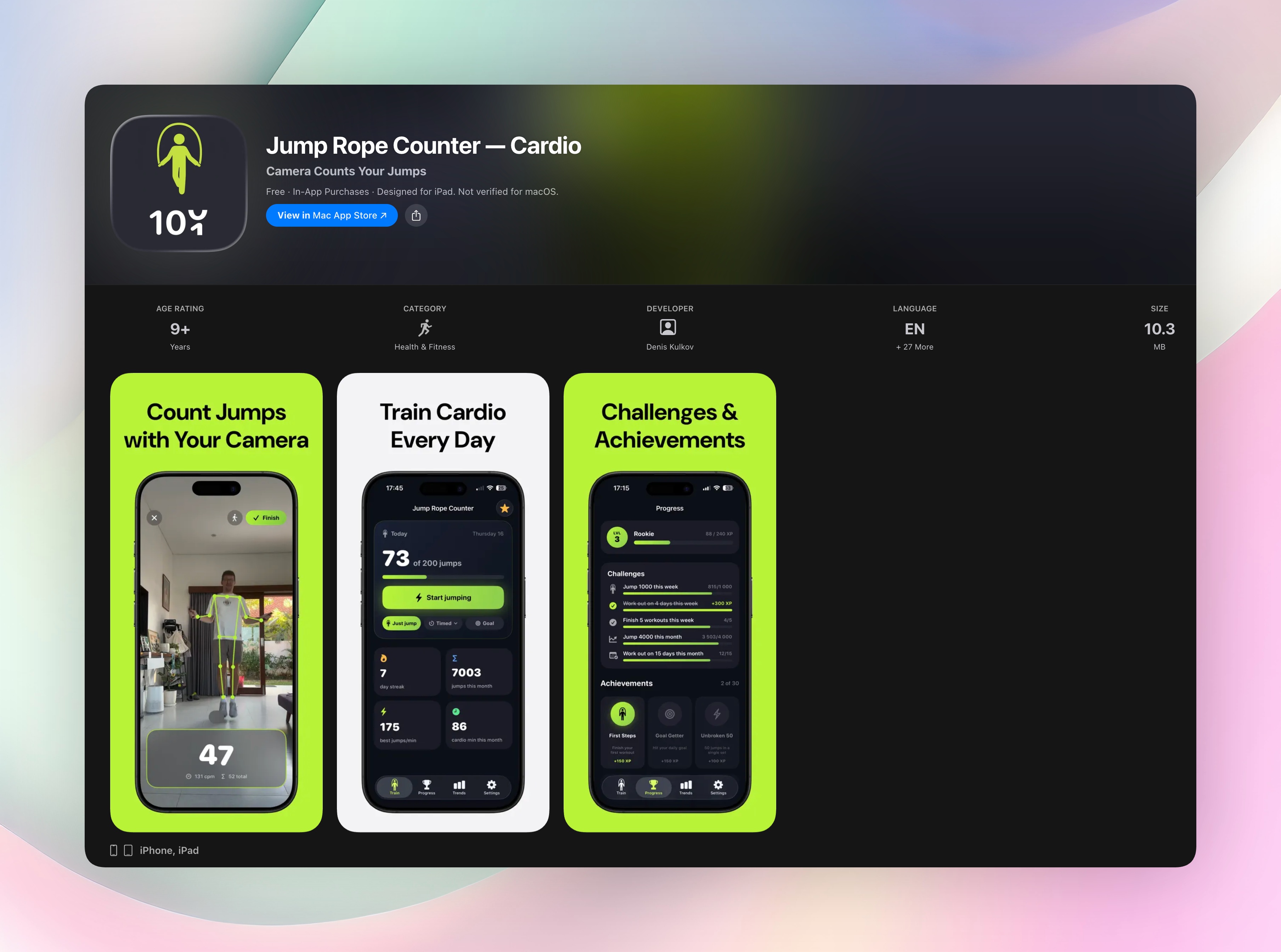
A plan written entirely in jump counts only works if the counts are honest, and counting to 900 in your head with burning calves is how day 18 quietly turns into day 12's number. Jump Rope Counter is a jump rope counter app for iPhone that counts jumps with the camera, so day 3 and day 30 are measured the same way.
Form rules that keep you in the challenge
Jump low. An inch or two of clearance is all the rope needs, and every extra inch is impact you pay for on day 20. Land on the balls of the feet, heels barely brushing the floor, knees soft.
Turn the rope with the wrists, elbows near the ribs. Swinging arms usually mean the rope is too long — standing on the midpoint, the handle tops should reach between your armpit and shoulder for a beginner, and shorten the rope as your cadence climbs. Our jump rope length chart has the specifics by height.
Surface matters more than shoes. Wood, a rubber gym mat, or a thin PVC mat over concrete all work; 30 straight days on bare concrete is the fastest route to shin splints and a quit on day 11. Mild calf tightness in week 1 is normal. Sharp shin pain isn't — take the light day early and cut the next build day by 20%.
What to do when you miss a day
Miss one day: repeat that day's number tomorrow and carry on. The block shifts by 24 hours and costs you nothing.
Miss two or three: restart the current four-day block. You finish a few days late with the progression intact.
Miss four or more: back up one full block. Foot and tendon conditioning fades faster than cardio, so a number that felt fine last week lands differently after a week off. Never double up to catch up — stacking two days into one is the most common way this challenge ends in an injury.
Jump rope results after 1 month
By day 30 the clear wins are conditioning and coordination. Trips per hundred jumps drop sharply, unbroken sets get long enough to be boring, and totals that wrecked you in week 1 become a warm-up. Calves, feet, and ankles get noticeably more durable.
Body composition moves slower. At a beginner's cadence of roughly 100 jumps a minute, 1,000 jumps is about ten minutes of actual work — real cardio, but not enough to outrun eating, so pair it with a deficit if that's the goal (jump rope for weight loss covers the math). Don't expect visible abs, and don't expect double unders to show up on their own.
Day 31: where the challenge goes next
Volume has done its job by day 30; piling on toward 2,000 and 3,000 mostly buys more time standing in one place. Pick one of three directions.
Hold 1,000 as a floor at four or five sessions a week — a maintenance dose you can keep for months. Convert the volume into intensity: 30 seconds hard, 30 off, ten rounds, chasing jumps per round instead of a daily total. Or spend the same ten minutes on skills — alternate foot, boxer step, high knees, crossovers, then double unders.
FAQ
How many jumps should a beginner start with?
100 in a session, split into sets if needed. That's low enough that your calves are fine the next morning, which is the only thing that matters in week 1. If 100 feels trivial, move to the intermediate track rather than inventing a bigger day 1.
Is 1,000 skips a day good?
For most people it's a solid daily cardio dose — roughly ten minutes of work at a moderate cadence, loading the calves, shoulders, and core. It's a sensible ceiling for a 30-day build and a good floor to maintain afterward. Much past it adds time without much extra stimulus.
Is 500 jumps a day enough to see results?
For conditioning and rope skill, yes. Done consistently, 500 a day fixes your rhythm and toughens the lower legs inside a month. What it won't do on its own is change the scale — results at that volume show up as endurance and control long before they show up in the mirror.
Can I really jump every single day for 30 days?
The plan is written for 30 consecutive days, and the light days are what make that survivable. If your shins or Achilles start complaining, swap a build day for a light day instead of pushing through. One extra light day beats a two-week layoff.
Free Jump Rope Counter tools
- Calories Burned CalculatorChoose an activity, enter its intensity, your duration and body weight, then get an estimate of calories burned per minute and total.
- Cardio Weekly PlannerPlan how much cardio per week with a simple schedule of minutes by intensity, a guideline comparison and a printable week view.
- Cycling Calories CalculatorEstimate calories burned cycling from your duration or distance, average speed, terrain and body weight. See calories per hour, per mile or km, and the MET used.
- Jogging Calories CalculatorEstimate calories burned while jogging from your body weight and either pace plus duration or distance plus time. See calories per mile, per km and the MET band used.
- Jump Rope Calories CalculatorEnter your body weight, session duration and jump rope pace to estimate total calories, calories per minute and the equivalent running time at 8 km/h.
- Jump Rope Challenge GeneratorCreate a deterministic jump rope challenge from your length, starting target and weekly progression percentage.
- Jump Rope Length by Height CalculatorEnter your height and jump-rope style or skill level to get a recommended rope length and a practical acceptable range.
- Jump Rope Workout for Beginners PlannerChoose your current level, available minutes and preferred work-to-rest ratio to build a progressive beginner jump-rope session.
- Jump Rope Workout Routine BuilderCreate a structured jump-rope routine with exercise blocks, work times, rest times and total interval targets.
- Jumping Jacks Calorie CalculatorEstimate how many calories burned doing 100 jumping jacks, or calculate a different rep count or duration using your weight, pace and intensity.
- Push Ups Calorie CalculatorEstimate calories burned, calories per rep, time taken and the reps needed to reach a calorie target.
- Steps to Calories CalculatorEstimate how many calories burned in 10000 steps, the distance those steps cover and the walking time at your chosen pace.
- Treadmill Calories CalculatorEstimate treadmill calories burned from speed, incline, duration, body weight and whether you are walking or running.
- Walking Calories CalculatorEstimate calories burned, calories per mile and kilometer, time taken and steps from your walking pace, incline, body weight and distance or duration.
- Zone 2 Heart Rate CalculatorCompare two methods for estimating your zone 2 heart rate range, then see the complete five-zone table. Enter a measured maximum heart rate when you have one.