
How long should my jump rope be? Sizing by height and rope type
For beginners, a jump rope should be about your height plus three feet — stand on the middle with one foot and the handle tops should hit your armpits. Speed jumpers go shorter, to the lower chest. Rope type shifts the answer a few inches either way.
How long should my jump rope be? Start with the step-on test
The step-on test is how to size a jump rope in about ten seconds — it beats any chart since it accounts for arm length, not just height. New to the movement? Pair it with our jump rope for beginners guide.
Stand tall with one foot on the middle of the cable. Pull both handles straight up along your sides, snug but not stretched, and read where the tops land:
- Armpit — beginner length, forgiving while your timing is rough.
- Between armpit and lower chest — general fitness, steady singles, crossovers.
- Lower chest, near the bottom of the sternum — speed work and double unders.
- Below the sternum — competitive speed, once your rope path is tight and repeatable.
Coaches disagree on the exact mark — some say shoulder, some armpit. Handle length matters too: "armpit" means a shorter cable with 6-inch handles than with 4-inch ones.
The height-plus-three-feet rule
If the rope's still in the box, use math: add 36 inches (91 cm) to your height for a starting length that lands most builds near armpit height. A speed cable wants less — add roughly 30 inches (76 cm) instead, closer to the lower chest.
One trap: a "9-foot rope" can mean cable only or cable-plus-handles depending on the brand. Check the spec, or buy adjustable.
Jump rope size chart by height
This chart uses height + 36 in for the starting length and height + 30 in for speed work — round to whatever your rope actually adjusts to.
| Your height | Beginner length | Speed / double-under length |
|---|---|---|
| 4'8"–5'0" (142–152 cm) | 7'8"–8'0" (234–244 cm) | 7'2"–7'6" (218–229 cm) |
| 5'1"–5'4" (155–163 cm) | 8'1"–8'4" (246–254 cm) | 7'7"–7'10" (231–239 cm) |
| 5'5"–5'8" (165–173 cm) | 8'5"–8'8" (257–264 cm) | 7'11"–8'2" (241–249 cm) |
| 5'9"–6'0" (175–183 cm) | 8'9"–9'0" (267–274 cm) | 8'3"–8'6" (251–259 cm) |
| 6'1"–6'4" (185–193 cm) | 9'1"–9'4" (277–284 cm) | 8'7"–8'10" (262–269 cm) |
| 6'5" and up (196+ cm) | 9'5" and up (287+ cm) | 8'11" and up (272+ cm) |
Jump rope length for height is a starting point, not a verdict — long arms and high hands both eat length.
Rope type and skill level shift the proper length
There's no single proper jump rope length across cables — drag and mass change how much slack you can get away with.
- PVC or licorice — thick and slow through the air; the drag hides sloppy form. Armpit high.
- Beaded — heavier and louder than PVC, built for tactile feedback. Run it long; the beads want room to swing.
- Coated steel speed cable — almost no air resistance, so extra length just becomes slack. Lower chest.
- Rope-weighted — extra mass carries momentum through the arc. Add an inch or two over your speed length.
- Handle-weighted — the cable is normal, so keep your normal length. The weight sits in your hands, not the arc.
Skill outranks rope type over time. Start at armpit length, learn the rhythm, then shorten in 2–3 inch (5–8 cm) steps, a week per step. Dropping two sizes at once just convinces you that you got worse.
Wrong-length symptoms and how to fix them
Diagnose by where the rope lands and what your body does to compensate.
Jump rope too long. The cable slaps the floor 6–12 inches in front of your toes instead of just under them. You jump higher and earlier to clear the slack, and the excess whips your shins and calves — that's a length problem, not a technique flaw.
Rope too short. It clips the crown of your head or catches your toes on the way under. To make room you flare your elbows, hunch, or pull into a tuck jump. Hands drifting wide of your hips is the tell.
Right length. Hands near the front of your hips, elbows close to your ribs, the rope clearing about an inch of floor each pass while you jump an inch or two.
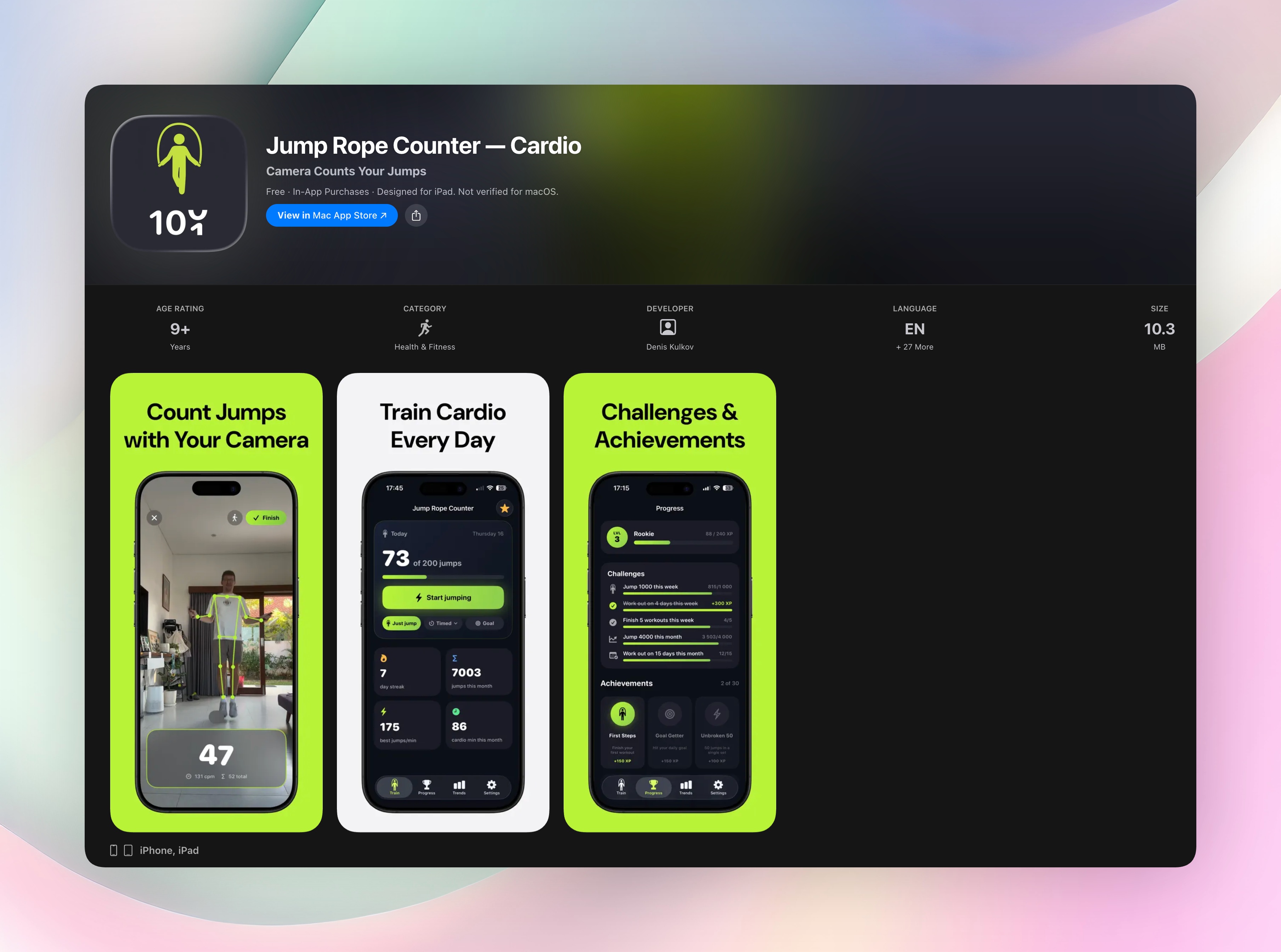
A sudden drop in your jumps per set is usually a rope problem, not a conditioning problem. If you swapped ropes, shortened one, or borrowed a friend's, check the count history before rewriting your training. Jump Rope Counter is a jump rope counter app for iPhone that counts jumps with the camera, so those per-set numbers are there to compare against last week's.
How to shorten a cable rope without ruining it
Most speed ropes are built to be shortened. The order matters more than the tools.
- Adjust before you cut. Pop the end cap or collar, loosen the set screw, slide the cable through, and retighten.
- Test with a knot first on PVC. Tie the extra into a knot below the handle and jump a few hundred reps — a trial before you cut anything permanent.
- Cut long. Leave 2–3 inches past where you think it should sit. You can always take more off; you can't put it back.
- Use cable cutters or side cutters, not scissors. Coated steel needs a clean shear — a crushing cut splits the coating and the strands unwind weeks later.
- Tape, then seal. Wrap electrical tape at the cut point, then seal it with heat shrink or super glue so the coating stays put. Never cut a cable that's still threaded and under tension.
Give the new length a week of easy sessions before judging it — our jump rope workout routines are a good, low-stakes way to spend that recalibration week.
FAQ
What size jump rope do I need if I'm 5'6"?
About 8 feet 6 inches for general jumping, or 8 feet for speed work. Confirm with the step-on test — handles at your armpits for the longer length, lower chest for the shorter one.
Is it better for a jump rope to be too long or too short?
Too long, by a small margin — it costs speed but you can still finish reps. A short rope catches your feet and head, and the only fix is more cable.
How do I know if my jump rope is too long?
Watch where the cable meets the floor. If it lands well in front of your toes, slaps loudly, or stings your shins, it's long — shorten 2–3 inches and test again.
Does jump rope length change for double unders?
Yes. Double unders need faster turnover and a tighter arc, so most people run 4–8 inches shorter than their single-under length — handles at the lower chest on the step-on test.
Free Jump Rope Counter tools
- Calories Burned CalculatorChoose an activity, enter its intensity, your duration and body weight, then get an estimate of calories burned per minute and total.
- Cardio Weekly PlannerPlan how much cardio per week with a simple schedule of minutes by intensity, a guideline comparison and a printable week view.
- Cycling Calories CalculatorEstimate calories burned cycling from your duration or distance, average speed, terrain and body weight. See calories per hour, per mile or km, and the MET used.
- Jogging Calories CalculatorEstimate calories burned while jogging from your body weight and either pace plus duration or distance plus time. See calories per mile, per km and the MET band used.
- Jump Rope Calories CalculatorEnter your body weight, session duration and jump rope pace to estimate total calories, calories per minute and the equivalent running time at 8 km/h.
- Jump Rope Challenge GeneratorCreate a deterministic jump rope challenge from your length, starting target and weekly progression percentage.
- Jump Rope Length by Height CalculatorEnter your height and jump-rope style or skill level to get a recommended rope length and a practical acceptable range.
- Jump Rope Workout for Beginners PlannerChoose your current level, available minutes and preferred work-to-rest ratio to build a progressive beginner jump-rope session.
- Jump Rope Workout Routine BuilderCreate a structured jump-rope routine with exercise blocks, work times, rest times and total interval targets.
- Jumping Jacks Calorie CalculatorEstimate how many calories burned doing 100 jumping jacks, or calculate a different rep count or duration using your weight, pace and intensity.
- Push Ups Calorie CalculatorEstimate calories burned, calories per rep, time taken and the reps needed to reach a calorie target.
- Steps to Calories CalculatorEstimate how many calories burned in 10000 steps, the distance those steps cover and the walking time at your chosen pace.
- Treadmill Calories CalculatorEstimate treadmill calories burned from speed, incline, duration, body weight and whether you are walking or running.
- Walking Calories CalculatorEstimate calories burned, calories per mile and kilometer, time taken and steps from your walking pace, incline, body weight and distance or duration.
- Zone 2 Heart Rate CalculatorCompare two methods for estimating your zone 2 heart rate range, then see the complete five-zone table. Enter a measured maximum heart rate when you have one.