How many calories does jumping rope burn — the real numbers
At a moderate 120 rpm, jumping rope burns roughly 11 to 22 calories a minute for most adults — about 140 calories in 10 minutes at 150 lb, 225 at 240 lb. Bodyweight and cadence set the number. Nearly every published figure assumes you never stop.
How many calories does jumping rope burn per minute
Calorie estimates for skipping all trace back to MET values — multiples of resting metabolic rate. The Compendium of Physical Activities, the reference table most online calculators quietly borrow from, splits rope jumping three ways:
- Slow, under 100 skips per minute — 8.8 METs
- Moderate, 100 to 120 skips per minute — 11.8 METs
- Fast, 120 to 160 skips per minute — 12.3 METs
The step from slow to moderate is big. The step from moderate to fast is almost nothing, which surprises people. Once the rope is turning steadily, most of the metabolic cost sits in lifting your bodyweight off the floor, and that stays roughly constant as the rope speeds up.
Here is jump rope calories burned per minute of continuous jumping, by bodyweight:
| Bodyweight | Slow (~100 rpm) | Moderate (~120 rpm) | Fast (~140 rpm) |
|---|---|---|---|
| 120 lb (54 kg) | 8.4 cal/min | 11.2 cal/min | 11.7 cal/min |
| 150 lb (68 kg) | 10.5 cal/min | 14.0 cal/min | 14.6 cal/min |
| 180 lb (82 kg) | 12.6 cal/min | 16.9 cal/min | 17.6 cal/min |
| 210 lb (95 kg) | 14.7 cal/min | 19.7 cal/min | 20.5 cal/min |
| 240 lb (109 kg) | 16.8 cal/min | 22.5 cal/min | 23.4 cal/min |
The formula, so you can run your own numbers
Every cell above comes out of one line of arithmetic:
calories per minute = MET × 3.5 × bodyweight in kg ÷ 200
A 180 lb jumper (81.6 kg) at moderate pace: 11.8 × 3.5 × 81.6 ÷ 200 = 16.9 calories a minute. Twenty minutes of that is about 337 calories.
Two caveats before you trust the output. First, it's a gross figure. MET math counts everything you burn during the activity, including the calorie or so per minute you'd have burned sitting still. Subtract 1 MET if you want the net cost — the calories the jumping actually added. At 150 lb over 30 minutes that's about 420 gross against roughly 385 net.
Second, the 3.5 ml/kg/min that defines 1 MET is a population average. Measured resting rates often land below it, which tilts every MET-derived estimate slightly high.
Jump rope calories for 10, 15, 20 and 30 minutes
Continuous moderate pace, calories at 10 / 15 / 20 / 30 minutes:
- 120 lb — 110 / 170 / 225 / 335
- 150 lb — 140 / 210 / 280 / 420
- 180 lb — 170 / 255 / 335 / 505
- 210 lb — 195 / 295 / 395 / 590
- 240 lb — 225 / 335 / 450 / 675
The 10-minute figure circulates hardest, usually flattened to "100 calories in 10 minutes." That's only right for a lighter person at a slow pace. The 30-minute number deserves more suspicion still — half an hour of unbroken rope work is an advanced capacity, not a default. Most people reach that duration as intervals, which is what a real jump rope workout looks like.
Cadence is the input you're most likely to get wrong
Everything above hangs on skips per minute, and 120 rpm is a guess the tables make on your behalf. A beginner working the basic bounce usually turns 70 to 100. Someone comfortable on a light speed rope sits nearer 150 to 180. That spread crosses two MET brackets, so misjudging cadence skews the estimate more than misjudging your bodyweight by 20 pounds.
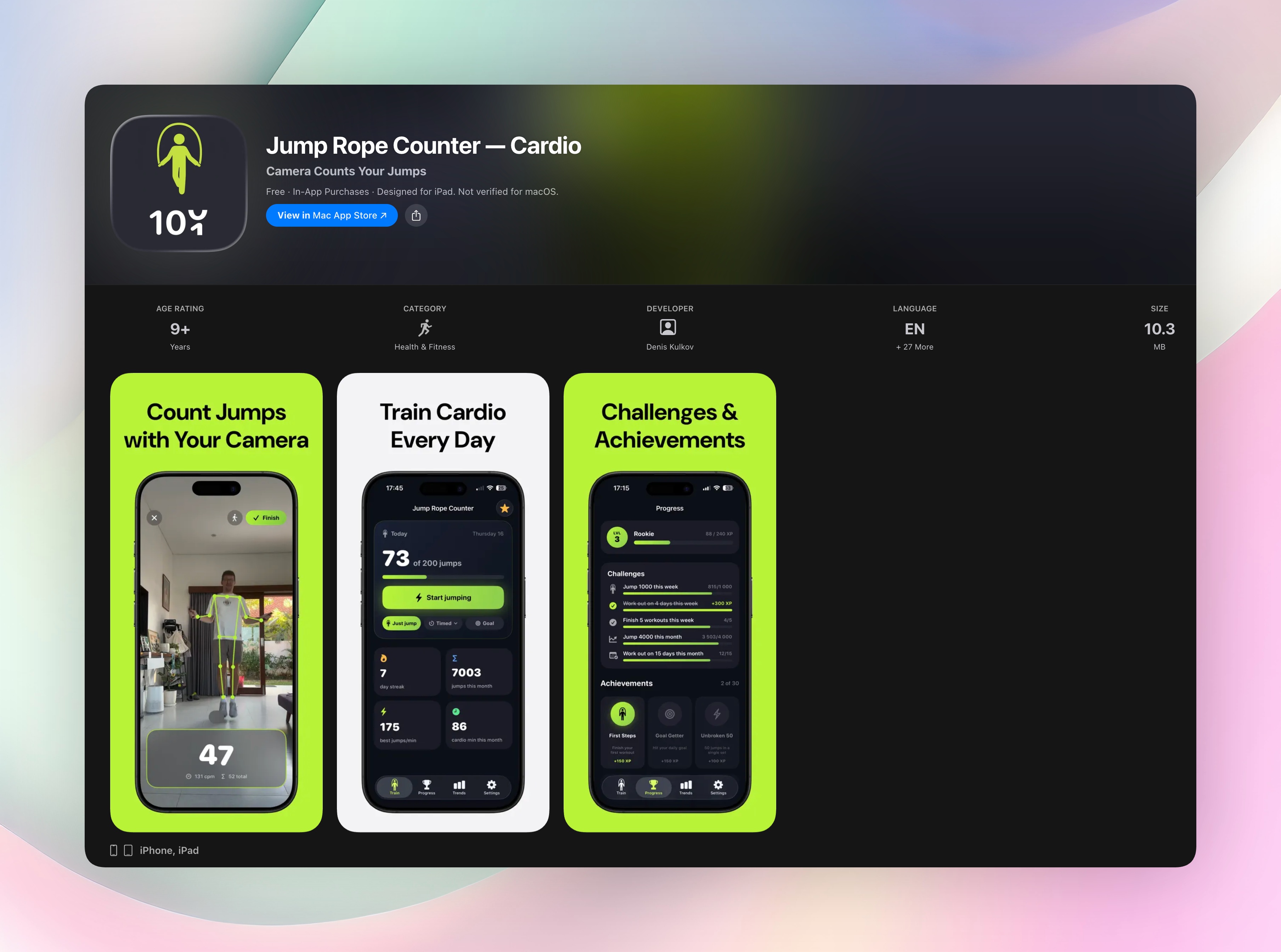
You can measure it instead. If you know how many jumps you completed and how many minutes you were actually on the rope, cadence is a division. Jump Rope Counter is a jump rope counter app for iPhone that counts jumps with the camera, so the session total is measured rather than remembered — divide it by your rope minutes and you have a real rpm to put in the formula.
One wrinkle: "skips per minute" in the MET tables means rope passes. For single-unders that matches your jump count exactly. For double-unders the rope passes twice per jump, so a double-under set reads slow in jumps while costing more than the jump count suggests.
The rest correction almost nobody applies
A 30-minute session is not 30 minutes of jumping. Missed reps, water breaks, rope adjustments, and the plain need to breathe all eat into it. Newer jumpers often accumulate 8 to 12 minutes of rope time in a half-hour session; experienced ones get 18 to 25.
Run the honest version. A 150 lb jumper, 30-minute session, 18 minutes on the rope at moderate pace: 18 × 14.0 = 253 calories. The other 12 minutes standing and recovering cost about 2 METs, or 2.4 calories a minute — another 29. Total: roughly 280, not the 420 the table promises.
That gap is where most jump rope calorie claims go wrong. If you're new to the rope, expect early sessions to land at roughly 40 to 50 percent of the headline number, not the full total, and expect the gap to close as your rope time grows.
What else moves the number, and what barely does
Technique. An efficient jumper clears the rope by about an inch. Someone bouncing six inches high does far more work per rope pass — which burns more per minute, but wears out sooner and usually cuts total session output.
Rope weight. Heavier ropes and weighted handles add forearm and shoulder demand. The effect on total burn is real but modest; it doesn't turn a 14 cal/min effort into 20.
Your fitness. As skill improves, movement economy improves with it, and burn per minute at a given cadence drifts down slightly. Higher intensity is what keeps the number climbing — one of the benefits of jumping rope is how fast that ceiling rises.
Afterburn. Elevated post-exercise oxygen consumption is genuine after hard interval work, but it's worth tens of calories, not hundreds. Don't budget meals around it.
FAQ
How many calories does jumping rope burn in 10 minutes?
Ten minutes of continuous moderate jumping burns about 110 calories at 120 lb, 140 at 150 lb, and 225 at 240 lb. If those ten minutes included rest, subtract for the standing time — the rate only applies while the rope is turning.
How many calories does skipping burn compared to running?
Moderate rope work sits around 11.8 METs against roughly 9.8 METs for a 6 mph run, so skipping burns more per minute. Running usually wins on session total, because most people can hold a run for 30 to 45 minutes and very few can hold the rope that long.
How many calories is 1,000 jumps?
At 120 rpm, 1,000 jumps takes about 8 minutes 20 seconds — roughly 117 calories at 150 lb and 141 at 180 lb. Bodyweight scales the result directly, so a jumper twice as heavy burns about twice as much.
Do weighted jump ropes burn more calories?
Somewhat. The added load recruits the forearms and shoulders harder, raising oxygen cost at the same cadence. Most people also turn a weighted rope slower, which claws back part of the gain, so treat it as a small bump rather than a different category.
Why do jump rope calorie calculators disagree?
They assume different cadences, draw on different MET tables, and some report net calories while others report gross. A calculator that never asks your skips per minute has picked a cadence for you, and that one assumption can move the answer by 30%.
Free Jump Rope Counter tools
- Calories Burned CalculatorChoose an activity, enter its intensity, your duration and body weight, then get an estimate of calories burned per minute and total.
- Cardio Weekly PlannerPlan how much cardio per week with a simple schedule of minutes by intensity, a guideline comparison and a printable week view.
- Cycling Calories CalculatorEstimate calories burned cycling from your duration or distance, average speed, terrain and body weight. See calories per hour, per mile or km, and the MET used.
- Jogging Calories CalculatorEstimate calories burned while jogging from your body weight and either pace plus duration or distance plus time. See calories per mile, per km and the MET band used.
- Jump Rope Calories CalculatorEnter your body weight, session duration and jump rope pace to estimate total calories, calories per minute and the equivalent running time at 8 km/h.
- Jump Rope Challenge GeneratorCreate a deterministic jump rope challenge from your length, starting target and weekly progression percentage.
- Jump Rope Length by Height CalculatorEnter your height and jump-rope style or skill level to get a recommended rope length and a practical acceptable range.
- Jump Rope Workout for Beginners PlannerChoose your current level, available minutes and preferred work-to-rest ratio to build a progressive beginner jump-rope session.
- Jump Rope Workout Routine BuilderCreate a structured jump-rope routine with exercise blocks, work times, rest times and total interval targets.
- Jumping Jacks Calorie CalculatorEstimate how many calories burned doing 100 jumping jacks, or calculate a different rep count or duration using your weight, pace and intensity.
- Push Ups Calorie CalculatorEstimate calories burned, calories per rep, time taken and the reps needed to reach a calorie target.
- Steps to Calories CalculatorEstimate how many calories burned in 10000 steps, the distance those steps cover and the walking time at your chosen pace.
- Treadmill Calories CalculatorEstimate treadmill calories burned from speed, incline, duration, body weight and whether you are walking or running.
- Walking Calories CalculatorEstimate calories burned, calories per mile and kilometer, time taken and steps from your walking pace, incline, body weight and distance or duration.
- Zone 2 Heart Rate CalculatorCompare two methods for estimating your zone 2 heart rate range, then see the complete five-zone table. Enter a measured maximum heart rate when you have one.