
Is jumping rope good cardio? The MET and heart-rate answer
Jumping rope is good cardio, and specifically vigorous cardio — a basic bounce sits around 9–12 METs, the same band as running 6–8 mph. The harder part isn't whether it works. It's controlling how hard it is.
Is jumping rope good cardio? Where it sits on the MET scale
One MET is your resting metabolic rate, about 3.5 mL of oxygen per kilogram per minute. Three to 5.9 METs is moderate intensity; 6 and up is vigorous. The Compendium of Physical Activities, which most guidelines lean on, rates skipping against the usual alternatives:
| Activity | METs | Intensity band |
|---|---|---|
| Rope, slow pace (under 100 skips/min) | 8.8 | Vigorous |
| Rope, moderate pace (100–120 skips/min) | 11.8 | Vigorous |
| Rope, fast pace (120–160 skips/min) | 12.3 | Vigorous |
| Treadmill running, 6 mph (10:00/mile) | 9.8 | Vigorous |
| Treadmill walking, 3.5 mph | 4.3 | Moderate |
| Elliptical, moderate effort | 5.0 | Moderate |
| Stationary bike, general | 7.0 | Vigorous |
The slowest listed rope pace is already vigorous. There's no moderate-intensity entry for skipping, because a rope turning slowly enough to be moderate won't clear your feet. These are averages for a cadence, not your personal cost: a heavier body or a higher jump pushes it up. Turning the numbers into calories is covered in how many calories does jumping rope burn.
Jump rope vs treadmill and other cardio machines
Jump rope vs treadmill. Metabolically close: a moderate bounce and a 10-minute mile land within a couple of METs. What differs is the dial. A treadmill runs continuously from 3 mph to a sprint; the rope's dial starts at 8.8 METs. Loading differs too: running spreads work across hip, knee, and ankle; the rope concentrates it in the calf, Achilles, and foot, with ground contacts often near 0.2 seconds.
Jump rope vs elliptical. The wider gap. The elliptical's listed moderate value is a little over half the rope's slowest pace, and the machine helps you: feet never leave the pedals, the flywheel covers each stroke's dead spot, and the handles let your arms share load rather than add it.
Stationary bike. You can coast. On a rope, the moment your hands stop, the set is over.
Jump rope heart rate: what cadence does to your zone
Zone models vary. The common five-band version splits max heart rate: zone 1 at 50–60% of HRmax, zone 2 at 60–70%, zone 3 at 70–80%, zone 4 at 80–90%, zone 5 above 90%. Coaches often use heart-rate reserve instead, which shifts every boundary up several beats, and endurance plans frequently use a three-zone lactate-threshold model. The bands below assume the five-zone version and 208 − 0.7 × age for HRmax, a better population fit than 220 minus age.
Roughly what cadence buys an untrained to moderately trained adult:
- 100–120 jumps per minute, boxer step, minimal clearance — the rope's practical floor. Upper zone 2 into low zone 3.
- 120–140 jpm, two-foot basic bounce — zone 3 into zone 4 within two or three minutes.
- 140–160 jpm, or double unders in blocks — zone 4, and zone 5 if you hold it.
- All-out 20–30 second bursts — zone 5. Heart rate lags effort by 20–30 seconds, so the peak reading lands after you stop.
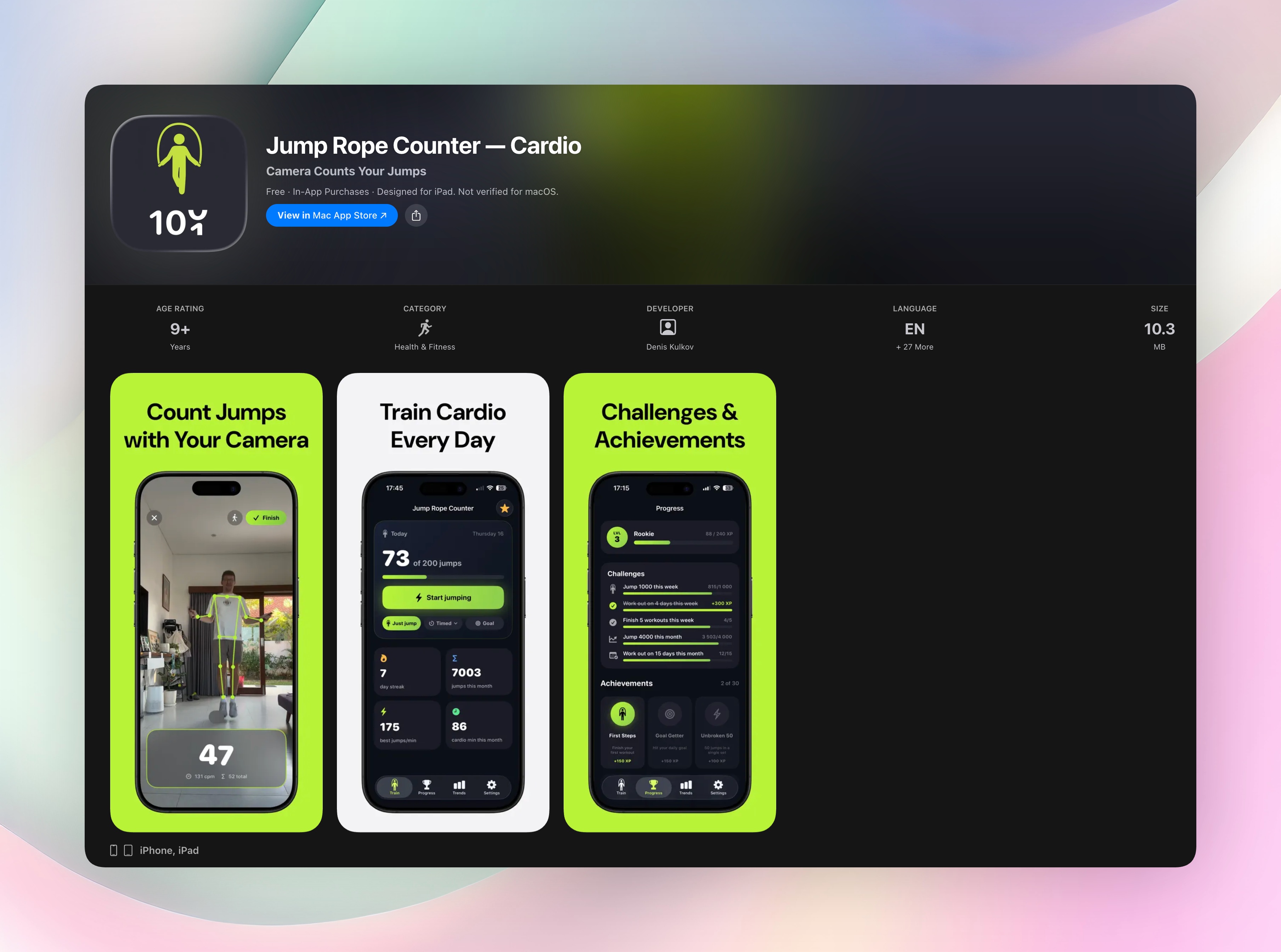
Cadence is the lever that sets the zone, and it's the lever that quietly slips: fatigue costs you rope speed before it costs you form, so a session planned at 130 drifts to 95 without feeling any easier. Jumps per minute is the only readout that catches that; Jump Rope Counter is a jump rope counter app for iPhone that counts jumps with the camera, which gives you a rate to hold yourself to.
Why the rope reaches zone 4 so fast
Three things stack. There's no coasting phase — every 400–500 ms you're loading or leaving the ground. The forearms and shoulders turn the rope nonstop, and small muscles working continuously push heart rate higher for a given oxygen uptake than leg work alone. And short ground contacts mean high rates of force development, so an anaerobic contribution arrives in the first minute, spiking heart rate before you feel warmed up.
The zone 2 problem
Zone 2 is the base-building band: conversational, sustainable for an hour, where most endurance plans put the bulk of their volume. It's the zone a rope is worst at delivering, because even the slowest practical pace already clears the vigorous-intensity threshold — for most adults, that puts you at the top of zone 2 or over the line into zone 3 within the first minute.
Three adjustments lower it:
- Alternate-foot or boxer step, which cuts vertical displacement per turn versus a two-foot bounce at the same cadence.
- Jump height. One to two centimeters of clearance is plenty; beginners routinely jump 10–15 cm and pay for all of it.
- Side swings. Swinging the rope beside your body without jumping is real active recovery inside a set.
Even so, most people should put easy volume on a bike or a walk and let the rope own zones 3 through 5. Trained skippers are the exception: economy improves until 120 jpm is conversational. How much volume that supports is covered in how long should i jump rope.
Jump rope for endurance and VO2 max
For raising VO2 max, the rope behaves like other vigorous intermittent work: hard intervals, incomplete recovery, repeated. Rope-training studies generally report gains in aerobic capacity. The much-repeated line that ten minutes of rope equals thirty minutes of jogging traces to a small, decades-old comparison and doesn't survive as a dose equivalence — the table above puts the two within a couple of METs per minute.
Where jump rope for endurance falls short is duration. The limiter in a long session is rarely cardiovascular — it's the calves, the Achilles, the plantar fascia, and coordination. Trip rate rises as technique degrades, and the restarts fragment the steady state you were chasing. Forty-five unbroken minutes of rope is a connective-tissue project, not a cardio one. Skip it when you're coming back from Achilles or plantar problems without a graded impact ramp, or when a session's point is high volume at low intensity — take the jump rope workout structures two or three times a week and put the long easy work elsewhere.
FAQ
Is jump rope a good cardio workout compared to running?
Per minute, yes — a moderate bounce rates around 11.8 METs against roughly 9.8 for a 10-minute mile. Running wins on duration and pace control, since you can run easy for an hour and adjust speed in small increments.
Is jumping rope a good exercise for beginners?
Yes, with a short ramp. Start at 30 seconds of jumping and 60 seconds of rest, five to eight rounds, three times a week, and add work time before cadence. Calf and foot tissue adapts more slowly than your heart does.
What heart rate should I aim for while jumping rope?
For a conditioning session, 70–85% of max — zones 3 and 4 — is where the rope naturally settles. Below that you're fighting the equipment; above it you're doing intervals, which is useful but not something to hold for 20 minutes.
How many minutes of rope count toward weekly cardio guidelines?
It counts at the vigorous rate, where one vigorous minute is credited as two moderate ones. Common targets ask for 75 to 150 minutes of vigorous activity per week, so 15 minutes of rope work five days a week clears the lower end.
Free Jump Rope Counter tools
- Calories Burned CalculatorChoose an activity, enter its intensity, your duration and body weight, then get an estimate of calories burned per minute and total.
- Cardio Weekly PlannerPlan how much cardio per week with a simple schedule of minutes by intensity, a guideline comparison and a printable week view.
- Cycling Calories CalculatorEstimate calories burned cycling from your duration or distance, average speed, terrain and body weight. See calories per hour, per mile or km, and the MET used.
- Jogging Calories CalculatorEstimate calories burned while jogging from your body weight and either pace plus duration or distance plus time. See calories per mile, per km and the MET band used.
- Jump Rope Calories CalculatorEnter your body weight, session duration and jump rope pace to estimate total calories, calories per minute and the equivalent running time at 8 km/h.
- Jump Rope Challenge GeneratorCreate a deterministic jump rope challenge from your length, starting target and weekly progression percentage.
- Jump Rope Length by Height CalculatorEnter your height and jump-rope style or skill level to get a recommended rope length and a practical acceptable range.
- Jump Rope Workout for Beginners PlannerChoose your current level, available minutes and preferred work-to-rest ratio to build a progressive beginner jump-rope session.
- Jump Rope Workout Routine BuilderCreate a structured jump-rope routine with exercise blocks, work times, rest times and total interval targets.
- Jumping Jacks Calorie CalculatorEstimate how many calories burned doing 100 jumping jacks, or calculate a different rep count or duration using your weight, pace and intensity.
- Push Ups Calorie CalculatorEstimate calories burned, calories per rep, time taken and the reps needed to reach a calorie target.
- Steps to Calories CalculatorEstimate how many calories burned in 10000 steps, the distance those steps cover and the walking time at your chosen pace.
- Treadmill Calories CalculatorEstimate treadmill calories burned from speed, incline, duration, body weight and whether you are walking or running.
- Walking Calories CalculatorEstimate calories burned, calories per mile and kilometer, time taken and steps from your walking pace, incline, body weight and distance or duration.
- Zone 2 Heart Rate CalculatorCompare two methods for estimating your zone 2 heart rate range, then see the complete five-zone table. Enter a measured maximum heart rate when you have one.