What muscles does jumping rope work — and does it build them?
Jumping rope works the calves hardest — gastrocnemius and soleus drive every takeoff — while the tibialis anterior, foot muscles, quads, glutes, and deep core stabilize each landing. The forearms and shoulders hold the rope turn isometrically. For most of that list it's a conditioning stimulus, not a growth stimulus.
What muscles does jumping rope work, from the ground up
A skip is a small hop — an inch or two of clearance — repeated at roughly 120 to 160 contacts per minute, faster for trained skippers. No single rep is hard. The demand comes from the count, which is why the tissue closest to the ground does most of the work.
Calves: soleus first, gastrocnemius second
The calf complex has two players. The gastrocnemius crosses both the knee and the ankle; the soleus sits underneath it and crosses only the ankle. Skipping keeps the knee softly bent rather than locked, which nudges a larger share of the plantarflexion toward the soleus — the muscle built for exactly this, being heavily slow-twitch and slow to fatigue.
Takeoff isn't pure muscular shortening either. Landing on the forefoot loads the Achilles tendon, which stores elastic energy and returns it into the next hop. The calf muscles behave more like stiff springs holding the ankle than like engines lifting a load. That's the mechanism behind first-week soreness: hundreds of low-force contractions instead of a handful of heavy ones.
Tibialis anterior, feet, and ankles
Between contacts, the tibialis anterior along the front of the shin dorsiflexes the ankle to clear the rope, sets the forefoot angle for the next landing, then controls the heel down. It's small and rarely trained directly, which is why the front of the shin often complains before the calves do.
Deeper down, the foot intrinsics and plantar fascia stiffen the arch on impact, while the peroneals resist the ankle rolling inward — the classic sprain direction. Side-to-side and single-leg variations lean on both far more than a basic bounce does.
Stabilizers: quads, glutes, and the deep core
The quads absorb each landing through a few degrees of knee flexion — small range, low tension per rep, high rep count. That's endurance work, not leg-day work. Glutes and hamstrings do less than people assume in a basic bounce; the hips stay near neutral, so they mostly keep the pelvis from collapsing. High knees and single-leg work change that.
The core works isometrically the entire time. Keeping the rib cage stacked over the pelvis is an anti-extension task for the deep abdominals and obliques, with the spinal erectors sharing it. Lose it and the low back arches and the rope starts catching your heels. That's also the honest answer on jump rope for abs — it trains them to hold a position under repeated impact, which isn't the same as growing them.
Upper body: forearms and shoulders, held still
Turned correctly, the rope is driven by the wrists — forearm flexors and extensors, plus grip — with the elbows in near the ribs. The deltoids and rotator cuff hold a static position; they barely move, they just refuse to move for ten minutes straight. Beginners who turn from the shoulders convert a small isometric job into a long-lever endurance job, which is why shoulders burn before anything else early on. Weighted ropes, typically a quarter pound up to a couple of pounds, shift work upstream to the shoulders and forearms on purpose.
Does jumping rope build muscle, or just condition it?
Hypertrophy needs mechanical tension, sets taken near enough to failure, and load that climbs over time. A rope caps out at your bodyweight and gives you ground contacts measured in fractions of a second. Sets end because you're out of breath or your calves are burning locally, not because a muscle mechanically failed.
The realistic ledger: local muscular endurance nearly everywhere, stiffer tendon and muscle-tendon behavior through the ankle, sharper reactive coordination, and modest calf growth — mostly in people who weren't already training calves directly. Everything above the waist gets conditioned rather than built. If you want size there, load it separately; the rope is one of the best conditioning tools you can carry, not a stand-in for resistance training.
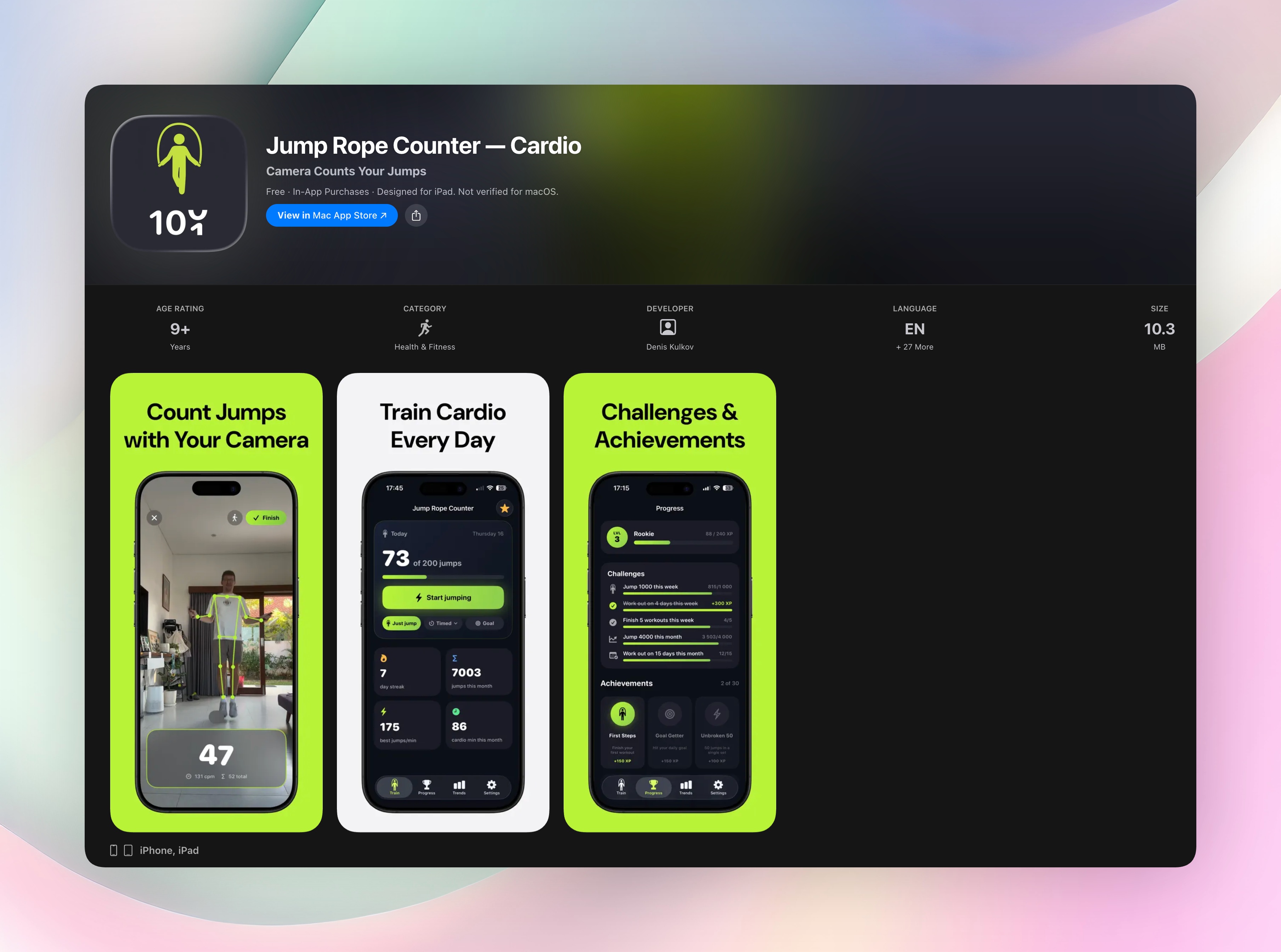
Calf adaptation in particular tracks accumulated ground contacts rather than session length. Ten minutes at 140 skips a minute is roughly 1,400 contacts, and it's the monthly total — not any single workout — that decides whether the calves toughen up or turn cranky. If you'd rather measure that than estimate it, Jump Rope Counter is a jump rope counter app for iPhone that counts jumps with the camera.
How variations shift the load
| Variation | Loads more | What changes |
|---|---|---|
| Basic bounce | Soleus, tibialis anterior | Baseline — smallest hop, highest sustainable cadence |
| Boxer skip | Calves, ankles, continuously | Weight shifts side to side, so one leg is always loaded |
| High knees | Hip flexors, quads, core | Iliopsoas and rectus femoris drive; heart rate climbs fast |
| Double unders | Calves, ankles, forcefully | Higher hop plus a faster wrist turn on every contact |
| Single-leg hops | Peroneals, gluteus medius | Doubles the load per leg and taxes lateral ankle stability |
| Weighted rope | Shoulders, forearms, grip | Upper-body time under tension rises; cadence drops |
None of these turn skipping into a strength exercise; they redistribute the same modest load. Rotating through two or three in a session spreads contact stress instead of hammering one structure, which is how most structured rope sessions get built.
FAQ
Is jump rope a full body workout?
It's a full-body conditioning workout in the sense that nearly every muscle is doing something, but most of them are stabilizing. Legs and calves get the real work; the upper body holds position. Treat a jump rope full body workout as cardio with a heavy ankle component, not as a replacement for strength training.
Will jumping rope make my calves bigger?
A little, if you don't already train calves, and mostly in the first few months. The stimulus is high-rep and low-load, which favors endurance qualities over size. Heavy, slow calf raises through a full range of motion will add more.
Does jumping rope work your abs?
Isometrically, yes. The abs and obliques resist the spine extending on every landing and keep the torso quiet so rope timing stays consistent. That builds coordination and endurance there; visible definition still comes down to body fat.
Why do my shins hurt when I jump rope?
Usually contact volume rather than technique alone. The tibialis anterior and the surrounding tissue adapt more slowly than your cardiovascular system does, so it's easy to add minutes faster than the shins can absorb them. Shorten sessions, jump on a forgiving surface, and build volume gradually — the beginner progression covers the ramp.
Free Jump Rope Counter tools
- Calories Burned CalculatorChoose an activity, enter its intensity, your duration and body weight, then get an estimate of calories burned per minute and total.
- Cardio Weekly PlannerPlan how much cardio per week with a simple schedule of minutes by intensity, a guideline comparison and a printable week view.
- Cycling Calories CalculatorEstimate calories burned cycling from your duration or distance, average speed, terrain and body weight. See calories per hour, per mile or km, and the MET used.
- Jogging Calories CalculatorEstimate calories burned while jogging from your body weight and either pace plus duration or distance plus time. See calories per mile, per km and the MET band used.
- Jump Rope Calories CalculatorEnter your body weight, session duration and jump rope pace to estimate total calories, calories per minute and the equivalent running time at 8 km/h.
- Jump Rope Challenge GeneratorCreate a deterministic jump rope challenge from your length, starting target and weekly progression percentage.
- Jump Rope Length by Height CalculatorEnter your height and jump-rope style or skill level to get a recommended rope length and a practical acceptable range.
- Jump Rope Workout for Beginners PlannerChoose your current level, available minutes and preferred work-to-rest ratio to build a progressive beginner jump-rope session.
- Jump Rope Workout Routine BuilderCreate a structured jump-rope routine with exercise blocks, work times, rest times and total interval targets.
- Jumping Jacks Calorie CalculatorEstimate how many calories burned doing 100 jumping jacks, or calculate a different rep count or duration using your weight, pace and intensity.
- Push Ups Calorie CalculatorEstimate calories burned, calories per rep, time taken and the reps needed to reach a calorie target.
- Steps to Calories CalculatorEstimate how many calories burned in 10000 steps, the distance those steps cover and the walking time at your chosen pace.
- Treadmill Calories CalculatorEstimate treadmill calories burned from speed, incline, duration, body weight and whether you are walking or running.
- Walking Calories CalculatorEstimate calories burned, calories per mile and kilometer, time taken and steps from your walking pace, incline, body weight and distance or duration.
- Zone 2 Heart Rate CalculatorCompare two methods for estimating your zone 2 heart rate range, then see the complete five-zone table. Enter a measured maximum heart rate when you have one.