Jump rope for boxers: the boxer skip and a six-round routine
Jump rope for boxers is built around the boxer skip — a shifting side-to-side step instead of a two-foot bounce. It roughly halves the landings each calf absorbs and keeps one foot loaded at all times. That's what makes six straight rounds survivable.
Why jump rope for boxers looks different from fitness skipping
A fitness class bounces on both feet, ankles locked, height consistent. A boxer jumping rope is closer to a sway: weight rolls from the lead foot to the rear foot and back, the free foot barely leaves the floor, knees soft throughout.
First, calf endurance without the pounding — alternating feet splits the landing load between legs at the same rope speed, so you can hold fifteen or twenty minutes instead of shredding your shins in five. Second, each pass rehearses moving weight between the lead and rear side, the mechanic behind stepping into a jab or loading the rear foot for a hook.
Skipping is not footwork practice — you're bouncing, fairly square, covering no ground. What rope work builds is rhythm, ankle and calf resilience, shoulder endurance from turning the rope, and the habit of staying relaxed up top while the legs work hard. That last one is what round six tests.
How to do the boxer skip
Stand tall, elbows tucked near the ribs, hands about a fist's width off your hips. The rope turns from the wrists and forearms; flaring elbows mean the rope is too short or you're muscling it with your shoulders.
- Start with a plain two-foot bounce for ten revolutions to find the tempo.
- Shift your weight onto the right foot as the rope passes; the left foot taps the floor with the ball only, carrying nothing.
- Reverse on the next pass. Left foot loads, right foot taps.
- Keep the hop under an inch. Clearing your feet by three inches is height you don't need.
- Stay on the balls of both feet. Heels touching down means you're landing, not skipping.
Fighters generally use a PVC "licorice" or beaded rope rather than a thin speed cable — the extra weight tells you where the rope is in the turn, and a miss stings less. Size it by standing on the middle with the handles pulled up: sternum-to-armpit height suits the boxer skip. If you're between sizes, check how long your jump rope should be.
A six-round boxing jump rope routine
Set a timer for three-minute rounds with one-minute rests — the men's professional standard. Women's professional rounds are usually two minutes, though some bouts have been contested at three; use the clock you actually fight on. The fixed rest is the point: you're training recovery on a schedule.
| Round | Focus | Cadence (jumps/min) | Jump target |
|---|---|---|---|
| 1 | Boxer skip, easy, find the rhythm | 120–130 | ~380 |
| 2 | Boxer skip with a crossover every 10 passes | 130–140 | ~400 |
| 3 | Running in place, knees driving | 140–160 | ~450 |
| 4 | Speed round, hard for the last 30 seconds | 150–180 | ~500 |
| 5 | Boxer skip, rebuild the rhythm while tired | 125–135 | ~390 |
| 6 | Double unders in sets of 10, boxer skip between | mixed | ~300 |
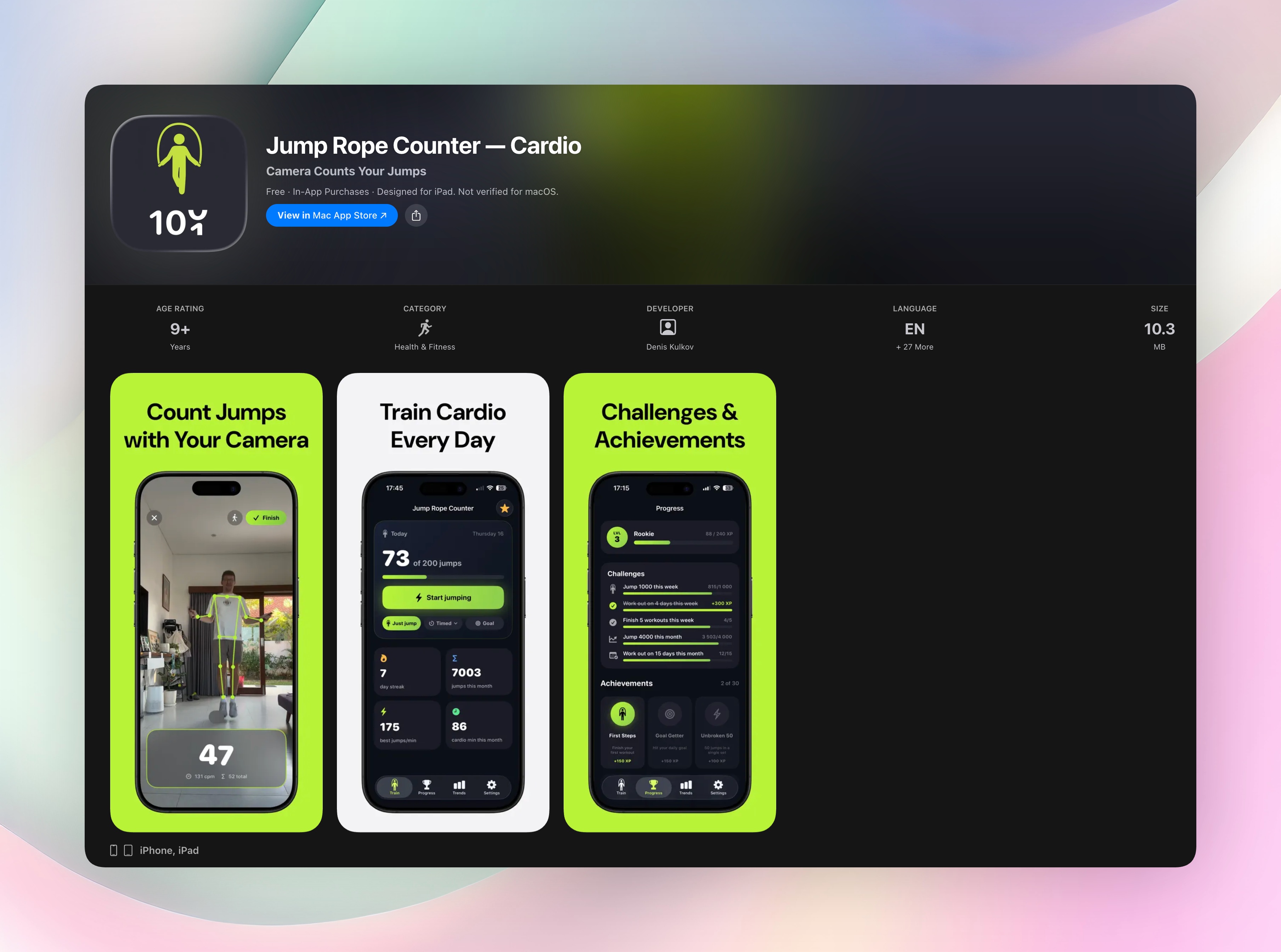
Counting those targets by hand while you're breathing hard doesn't work. Jump Rope Counter is a jump rope counter app for iPhone that counts jumps with the camera, so you can compare round one against round six and see exactly where conditioning falls off.
That's the skeleton of any skipping rope boxing workout: fixed rounds, fixed rests, one job.
The trick progression fighters actually use
Tricks earn their place by raising intensity without breaking rhythm.
Running in place. An exaggerated boxer skip with real knee drive. Rope speed climbs to match the legs, so heart rate rises with no new coordination demand. Learn it first.
Crossovers. Cross your arms at the wrists so the loop opens in front of you, jump through, uncross on the next pass. Practice the side swing first — rope swept to one side, no jump — until the timing is automatic. Breakdown in jump rope tricks and crossovers.
Double unders. The rope passes twice per jump, driven by a sharper wrist snap rather than a bigger arm swing, with a slightly higher hop to buy the time. Fighters use them as finishers — ten at the end of each minute, or one unbroken set to close the last round. Double unders are the one trick that meaningfully adds conditioning; releases and 360s are showmanship.
Fitting rope work around bag and sparring days
Two or three easy rounds before bag work or sparring is a warm-up, not a workout — cadence stays conversational and you stop while you still feel springy. Heavy rope right before sparring leaves you flat-footed in the first round.
The conditioning version, six to ten rounds, belongs on non-sparring days or after bag work. Because the boxer skip jump rope pattern stays low-impact when the hops stay small, most fighters rope four to six days a week. Achilles or shin soreness that lingers into the next day means the jumps got too high or the floor is too hard — concrete punishes, a mat or wood floor doesn't.
FAQ
How long should a boxer jump rope each day?
Ten to twenty minutes of real work — three to six rounds — covers most fighters. Warm-up-only days can be two easy rounds. Volume matters more than speed early on.
Is the boxer skip better than a regular two-foot bounce?
For volume, yes: alternating feet splits the landing load and lets you rope far longer at the same speed. Keep the two-foot bounce for double unders and for finding your tempo at the start of a round.
What kind of rope do boxers use?
A PVC licorice or beaded rope, both heavier than a speed cable. The added weight gives feedback through the turn and survives concrete better. Speed cables are for competitive skippers chasing revolutions.
Does jumping rope replace roadwork?
Not entirely. It builds a similar aerobic base with less joint load and better rhythm carryover, but it doesn't reproduce the sustained low-intensity work of a long run. Most camps do both.
Free Jump Rope Counter tools
- Calories Burned CalculatorChoose an activity, enter its intensity, your duration and body weight, then get an estimate of calories burned per minute and total.
- Cardio Weekly PlannerPlan how much cardio per week with a simple schedule of minutes by intensity, a guideline comparison and a printable week view.
- Cycling Calories CalculatorEstimate calories burned cycling from your duration or distance, average speed, terrain and body weight. See calories per hour, per mile or km, and the MET used.
- Jogging Calories CalculatorEstimate calories burned while jogging from your body weight and either pace plus duration or distance plus time. See calories per mile, per km and the MET band used.
- Jump Rope Calories CalculatorEnter your body weight, session duration and jump rope pace to estimate total calories, calories per minute and the equivalent running time at 8 km/h.
- Jump Rope Challenge GeneratorCreate a deterministic jump rope challenge from your length, starting target and weekly progression percentage.
- Jump Rope Length by Height CalculatorEnter your height and jump-rope style or skill level to get a recommended rope length and a practical acceptable range.
- Jump Rope Workout for Beginners PlannerChoose your current level, available minutes and preferred work-to-rest ratio to build a progressive beginner jump-rope session.
- Jump Rope Workout Routine BuilderCreate a structured jump-rope routine with exercise blocks, work times, rest times and total interval targets.
- Jumping Jacks Calorie CalculatorEstimate how many calories burned doing 100 jumping jacks, or calculate a different rep count or duration using your weight, pace and intensity.
- Push Ups Calorie CalculatorEstimate calories burned, calories per rep, time taken and the reps needed to reach a calorie target.
- Steps to Calories CalculatorEstimate how many calories burned in 10000 steps, the distance those steps cover and the walking time at your chosen pace.
- Treadmill Calories CalculatorEstimate treadmill calories burned from speed, incline, duration, body weight and whether you are walking or running.
- Walking Calories CalculatorEstimate calories burned, calories per mile and kilometer, time taken and steps from your walking pace, incline, body weight and distance or duration.
- Zone 2 Heart Rate CalculatorCompare two methods for estimating your zone 2 heart rate range, then see the complete five-zone table. Enter a measured maximum heart rate when you have one.