
Jump rope double unders: why they fail and how to fix them
A double under is one jump with two rope passes, and it comes from spinning the rope faster — not jumping higher. Most people learning jump rope double unders fail on wrist speed and timing, not on fitness. Fix the rope, the hands, and the rhythm, and the first rep shows up fast.
Why jump rope double unders fail
Three faults cause almost every miss, and they usually arrive together.
Jumping higher. A single under needs an inch or two of clearance; a double needs three or four. Going higher than that costs energy, not time — a double under is a faster wrist turn, not a bigger jump.
Bending the knees. Tucking the knees up or kicking the heels back feels like it makes room for the cord. It doesn't — both fold you in mid-air and shorten the gap the rope has to clear. Legs long, toes down, body straight.
Pulling the arms wide. When the second pass feels slow, people reach for it — elbows flare, hands drift back past the hips. That shrinks the rope's arc on your side, which turns a near-miss into a welt. Hands sit about hip height, six to ten inches out, elbows near the ribs — and stay there.
Double unders vs single unders: what actually changes
| Single unders | Double unders | |
|---|---|---|
| Rope passes per jump | 1 | 2 |
| Jump height | ~1–2 in | ~3–4 in |
| Typical steady cadence | 120–180 jumps/min | 100–140 jumps/min |
| Main limiter | conditioning | wrist speed and timing |
The number that matters is air time — both rope passes have to fit inside roughly half again as long as a single jump's hang time. Every real fix lives in the wrists and forearms, not the legs.
Rope, length, and surface
Gear affects how fast jumping rope double under work clicks, and three things matter most.
Cable. Bare steel and ultra-thin coated cable (1.8–2 mm) spin fastest but give little feedback and sting on a miss. Learn on a 2.5 mm coated cable or 4 mm PVC cord instead — heavy enough to feel the rope's arc.
Length. Stand on the cord's middle and pull the handles up: for learning doubles, the tops should reach roughly your armpits. Experienced jumpers size shorter, toward the sternum, but a short rope forces a taller jump and multiplies whips while you're still missing. See how long your jump rope should be for sizing by height.
Surface. Rubber gym flooring, hardwood, or plywood. Grass and carpet drag the cord and hide mistiming; deep mats kill the bounce; concrete is hard on the Achilles. You also want to hear the rope — two clean clicks per jump means the timing is right.
How to do double unders: the four-step progression
Most double under tips reduce to one instruction — keep the jump small and the hands still. This double under progression builds that. Start it once you can do 50 unbroken single unders without thinking; if you can't, start with the beginner's guide to jumping rope.
1. Power singles
Single unders at normal rope speed, jumping three to four inches instead of one. Sets of 20. You're learning to hold a tight, straight shape at double-under height without changing anything about the arms.
2. Penguin taps, then tap-tap-double
Drop the rope. Jump, and tap your thighs twice before landing — that's the double beat, two hand pulses per jump. Sets of 15. Then pick the rope back up and do single, single, double, so the double doesn't come out of nowhere.
3. One double every ten singles
Now make it continuous: ten singles, one double, ten singles, one double. The goal isn't the double — it's landing out of it back into singles without stopping.
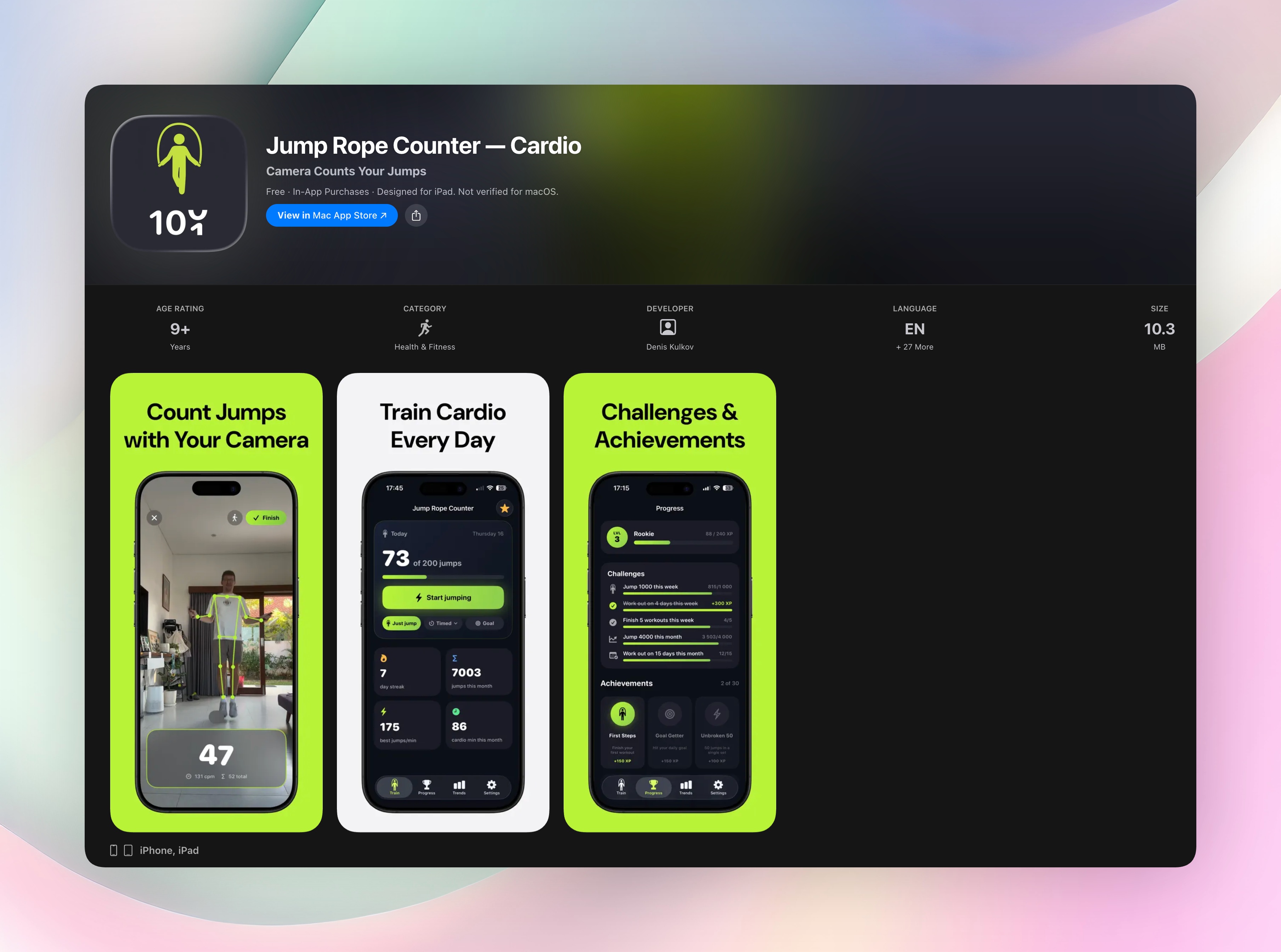
Counting is the quiet problem here. Tracking singles in your head spends attention on arithmetic right when the rhythm needs it, and the double falls apart on rep nine. Let something else hold the number — Jump Rope Counter is a jump rope counter app for iPhone that counts jumps with the camera, so you can check the total afterward instead of running a tally mid-set.
4. Consecutive sets
Two in a row, then three, five, ten. Back-to-back doubles are a separate skill — the landing has to reload the next jump, so ground contact shortens and hands can't drift. Stop the moment jump height creeps up; that just grooves the fault.
A realistic timeline to a set of ten
With solid singles, a first double usually shows up within one to three sessions. Ten unbroken takes longer: a month or two of short, frequent practice for most people — five to ten minutes, three to five days a week.
Keep early volume low. Doubles load the calves and Achilles harder than singles, and the soreness afterward often outpaces how the session felt. Treat them as skill work up front, and fold them into your jump rope workout routine once you can hit a set of five on demand.
Fixing whip marks on your forearms
Whips come from the hands, not the rope. When the arms flare or slide back behind the hip line mid-set, the cord's loop narrows on your side of the body and clips the inner forearm on the way around.
Three fixes, in order: park the hands slightly forward of the hip line; shorten the rope two or three inches if the second pass scrapes the floor; and stay off bare steel while learning. A long-sleeve shirt for a few weeks removes the flinch that makes you pull your arms wider next rep.
FAQ
How do you get your first double under?
Do ten single unders, then jump three or four inches higher and flick the wrists twice on that one jump. Don't tuck, don't reach. Most people land their first double within a few sessions once singles are automatic.
Should you use a heavier or lighter rope for double unders?
Slightly heavier — a 2.5 mm coated cable or 4 mm PVC cord gives feedback on where the rope is in its arc. Switch to lighter once you're stringing ten together.
Why do my double unders stop after two or three reps?
Jump height creeping up and hands drifting apart under fatigue, almost always, and both start right after the first rep. Film a set from the side — the fault is obvious on video and invisible from the inside.
Are double unders bad for your calves?
They load the calves and Achilles harder than single unders because of the extra height and faster ground contact. That's trainable, not harmful, but ramp volume gradually and take a few days off if the Achilles feels tender rather than just sore.
Free Jump Rope Counter tools
- Calories Burned CalculatorChoose an activity, enter its intensity, your duration and body weight, then get an estimate of calories burned per minute and total.
- Cardio Weekly PlannerPlan how much cardio per week with a simple schedule of minutes by intensity, a guideline comparison and a printable week view.
- Cycling Calories CalculatorEstimate calories burned cycling from your duration or distance, average speed, terrain and body weight. See calories per hour, per mile or km, and the MET used.
- Jogging Calories CalculatorEstimate calories burned while jogging from your body weight and either pace plus duration or distance plus time. See calories per mile, per km and the MET band used.
- Jump Rope Calories CalculatorEnter your body weight, session duration and jump rope pace to estimate total calories, calories per minute and the equivalent running time at 8 km/h.
- Jump Rope Challenge GeneratorCreate a deterministic jump rope challenge from your length, starting target and weekly progression percentage.
- Jump Rope Length by Height CalculatorEnter your height and jump-rope style or skill level to get a recommended rope length and a practical acceptable range.
- Jump Rope Workout for Beginners PlannerChoose your current level, available minutes and preferred work-to-rest ratio to build a progressive beginner jump-rope session.
- Jump Rope Workout Routine BuilderCreate a structured jump-rope routine with exercise blocks, work times, rest times and total interval targets.
- Jumping Jacks Calorie CalculatorEstimate how many calories burned doing 100 jumping jacks, or calculate a different rep count or duration using your weight, pace and intensity.
- Push Ups Calorie CalculatorEstimate calories burned, calories per rep, time taken and the reps needed to reach a calorie target.
- Steps to Calories CalculatorEstimate how many calories burned in 10000 steps, the distance those steps cover and the walking time at your chosen pace.
- Treadmill Calories CalculatorEstimate treadmill calories burned from speed, incline, duration, body weight and whether you are walking or running.
- Walking Calories CalculatorEstimate calories burned, calories per mile and kilometer, time taken and steps from your walking pace, incline, body weight and distance or duration.
- Zone 2 Heart Rate CalculatorCompare two methods for estimating your zone 2 heart rate range, then see the complete five-zone table. Enter a measured maximum heart rate when you have one.