Jump rope tricks: the cue that unlocks each move
Jump rope tricks come in three tiers: footwork you can learn in one session, arm crosses that take a week or two of wrist work, and multi-pass tricks that need real jump height. Each has a cue that makes it click faster than any amount of watching.
Jump rope tricks for beginners: boxer skip, alternate foot, side swing
Boxer skip. Weight shifts side to side with both feet under your hips — one taps while the other carries the load, then they swap. Cue: don't lift both feet, just unweight one. It's the cheapest skip in the sport, which is why boxers live in it. If basic bounces still catch your toes, start with jump rope for beginners.
Alternate foot step. Jogging in place through the rope, one foot per pass. Cue: keep the trailing heel low and let the ankle work instead of the knee.
Side swing. Both handles come together beside one hip and the rope draws a full circle in the plane next to you — no jumping through it. Cue: hands stay glued together, and the elbow drives the circle, not the shoulder. The jump rope side swing is the connector move most freestyle combos are built around.
Intermediate jump rope tricks: crossover, high knees, double under
Crossover (criss-cross). Same trick, two names most coaches use interchangeably. Cue: cross at the forearms, deep, each hand finishing past the opposite hip. The loop is only as wide as your hands are apart, so a shallow cross leaves an opening the size of your shin. Most first clean crossover jump rope reps come from exaggerating it until it feels theatrical.
High knees. An alternate foot step with the knee driven toward hip height. Cue: don't chase the rope with faster wrists — hold the rope speed and let the knee rise inside it. Jump rope high knees are a conditioning trick, not a skill trick.
Double under. Two rope passes per jump. Cue: it's wrist speed, not jump height — a jump slightly higher than your basic bounce is enough if the wrists snap. Full progression in jump rope double unders.
Advanced jump rope tricks: side-swing crossover, front-back cross, triple under
Side-swing crossover. A side swing that opens straight into a cross. Cue: the cross is already forming while the rope is still beside you — wait for it to come around and you're a beat late.
Front-back cross. One arm crosses in front of the body while the other tucks behind your back at the hip pocket. Cue: the back hand does almost nothing — it parks and anchors while the front hand carries the rope over. Most failures come from steering with the back arm.
Triple under. Three passes per jump, and two things change at once: more air than a double under, plus a wrist turn fast enough to fit a third pass in. Drill double unders with an exaggerated jump until you land with time to spare, then add the pass.
Which jump rope tricks build fitness, and which are pure skill
| Trick | What it changes | Effort vs basic bounce |
|---|---|---|
| Boxer skip | Weight shifts side to side | Lower — it's the rest step |
| Alternate foot step | One foot per rope pass | Similar, easier to sustain |
| Side swing | No jump at all | Lower — a built-in breather |
| Crossover | Arm path only | About the same |
| High knees | Hip flexion and jump height | Higher, and it climbs fast |
| Double under | Rope speed and jump height | Much higher |
| Triple under | Everything at once | Highest, and not sustainable |
Skill tricks let you keep skipping while your legs recover; intensity tricks belong in intervals. A round of only crosses and side swings is technique work, not cardio.
Chaining tricks into a jump rope freestyle combo
Freestyle is phrased, not random. Count in 8s and give each trick a fixed slot — four basic bounces, two side swings, two crossovers, repeat. Every trick needs an entry and an exit; the exit is what gets skipped, and a crossover you can enter but can't uncross cleanly is half a trick. Build by pairing, not stacking, with side swings as the glue.
Drilling transitions without losing the rope
Practice the seam, not the trick. When a combo breaks, the failure is at the handoff. Isolate two moves and repeat only the switch — handles and no rope first, if the pattern is new.
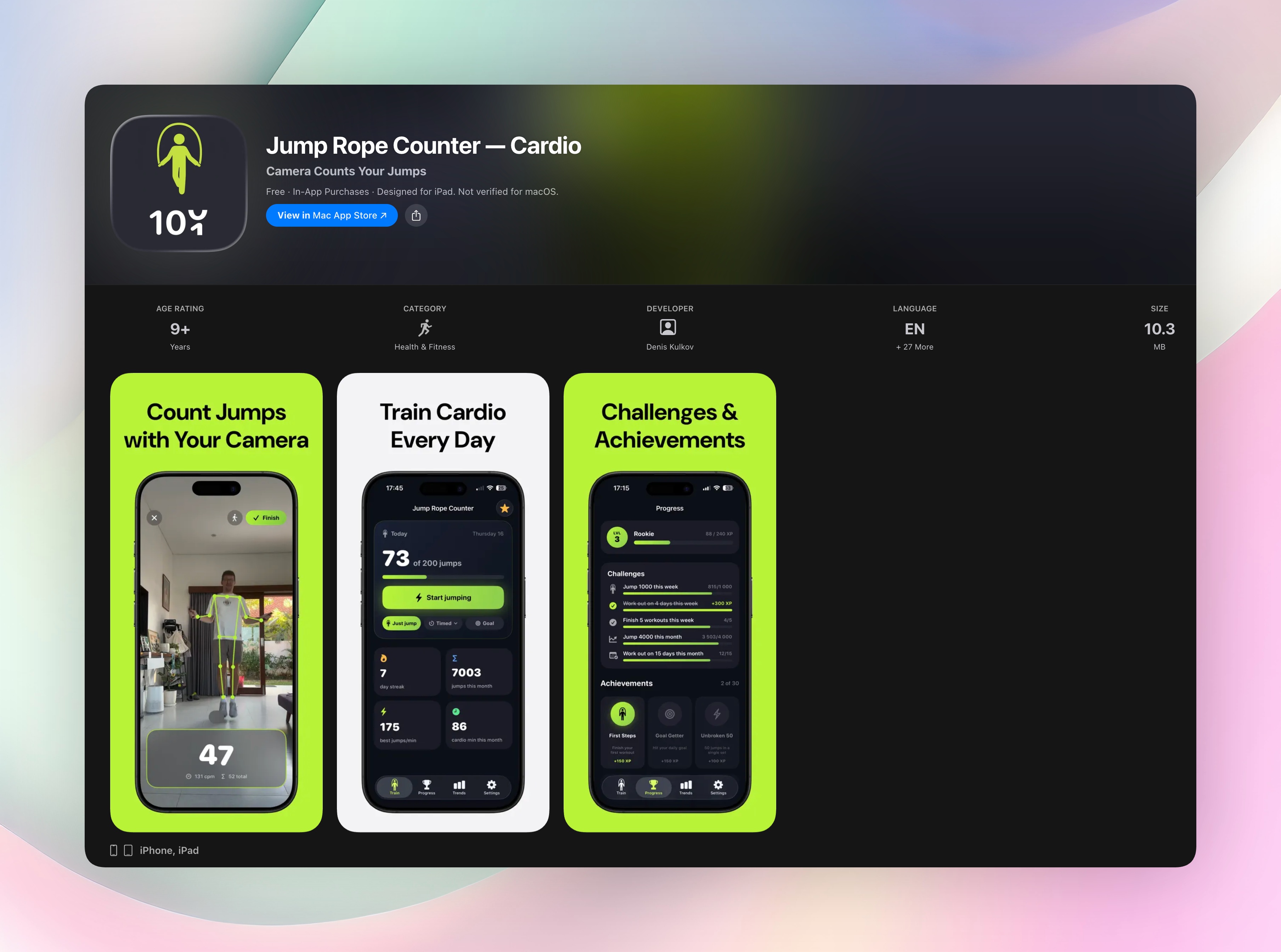
Score sets instead of judging by feel. Run a trick as attempts and clean reps: 10 tries, 6 landed, that's your number for the day. Feel lies: the session a crossover finally felt smooth is often the one where the rate stayed flat. Jump Rope Counter is a jump rope counter app for iPhone that counts jumps with the camera, so each set ends with a real total instead of an estimate.
Size the rope for the trick. Crosses forgive a slightly longer rope because the loop starts bigger; speed and multi-unders want it shorter and stiffer. Check how long should my jump rope be before blaming your hands.
FAQ
What jump rope trick should I learn first?
The boxer skip. It's the easiest to get and it extends how long you can stay in a set, which means more reps of everything else. Side swings come next, since so many tricks are entered through one.
How long does it take to learn the crossover?
One clean rep usually takes a few sessions; doing it on demand takes longer. The deciding factor is how deep you cross, not how many hours you log.
What's the difference between the two jump rope styles?
Competition splits into speed and freestyle. Speed events are timed sprints — 30-second and 3-minute formats are standard — and count foot contacts. Freestyle is judged on difficulty and presentation.
Why does my rope hit my feet when I cross?
Almost always a shallow cross. Your hands have to travel past the opposite hip to open a loop wide enough to clear your feet. Too short or too light a rope makes it worse.
Free Jump Rope Counter tools
- Calories Burned CalculatorChoose an activity, enter its intensity, your duration and body weight, then get an estimate of calories burned per minute and total.
- Cardio Weekly PlannerPlan how much cardio per week with a simple schedule of minutes by intensity, a guideline comparison and a printable week view.
- Cycling Calories CalculatorEstimate calories burned cycling from your duration or distance, average speed, terrain and body weight. See calories per hour, per mile or km, and the MET used.
- Jogging Calories CalculatorEstimate calories burned while jogging from your body weight and either pace plus duration or distance plus time. See calories per mile, per km and the MET band used.
- Jump Rope Calories CalculatorEnter your body weight, session duration and jump rope pace to estimate total calories, calories per minute and the equivalent running time at 8 km/h.
- Jump Rope Challenge GeneratorCreate a deterministic jump rope challenge from your length, starting target and weekly progression percentage.
- Jump Rope Length by Height CalculatorEnter your height and jump-rope style or skill level to get a recommended rope length and a practical acceptable range.
- Jump Rope Workout for Beginners PlannerChoose your current level, available minutes and preferred work-to-rest ratio to build a progressive beginner jump-rope session.
- Jump Rope Workout Routine BuilderCreate a structured jump-rope routine with exercise blocks, work times, rest times and total interval targets.
- Jumping Jacks Calorie CalculatorEstimate how many calories burned doing 100 jumping jacks, or calculate a different rep count or duration using your weight, pace and intensity.
- Push Ups Calorie CalculatorEstimate calories burned, calories per rep, time taken and the reps needed to reach a calorie target.
- Steps to Calories CalculatorEstimate how many calories burned in 10000 steps, the distance those steps cover and the walking time at your chosen pace.
- Treadmill Calories CalculatorEstimate treadmill calories burned from speed, incline, duration, body weight and whether you are walking or running.
- Walking Calories CalculatorEstimate calories burned, calories per mile and kilometer, time taken and steps from your walking pace, incline, body weight and distance or duration.
- Zone 2 Heart Rate CalculatorCompare two methods for estimating your zone 2 heart rate range, then see the complete five-zone table. Enter a measured maximum heart rate when you have one.